
Can You Upgrade Your Lead Acid EV Bike to Lithium? Step-by-Step Guide

If you own an electric bike in Pakistan with a lead acid or gel battery, you have probably noticed the frustrating reality: range drops after a few months, the bike feels sluggish in summer, and you find yourself charging more often than riding.
Quick answer
Which lithium battery fits my EV bike?
To convert lead acid to lithium EV bike, match the pack to your controller voltage: 48V, 51.2V, 60V, 63V, 72V or 76V, in 20Ah to 60Ah. Hybrid EV Engineering builds the pack to your battery compartment shape, so it drops into the same space.
The good news? You do not have to buy a new bike. You can upgrade your existing EV bike to lithium and transform its performance completely.
This guide will walk you through everything you need to know about converting your lead acid EV bike to lithium, including the process, costs, benefits, and what to expect after the upgrade.
Why Are You Struggling with Your Current Lead Acid Battery?
Before we discuss the upgrade, let us understand why your current battery is causing problems. This will help you appreciate the difference lithium makes.
The Reality of Lead Acid Batteries in Pakistan
Most Chinese electric bikes sold in Pakistan come with lead acid or gel batteries. These batteries have several limitations that become worse in Pakistani conditions:
- Short lifespan: Only 300 to 500 charge cycles before significant degradation
- Heavy weight: A typical 72V 20Ah lead acid pack weighs 35 to 40 kg
- Poor heat tolerance: Performance drops dramatically above 40°C
- Voltage sag: Power delivery weakens as the battery discharges
- Long charging time: 8 to 10 hours for a full charge
- Memory effect: Partial charging reduces overall capacity over time
In Pakistani summers where temperatures regularly exceed 45°C, these problems multiply. Your battery that once gave 60 km range might now struggle to deliver 25 km.
Sound familiar? You are not alone. This is exactly why thousands of EV bike owners in Pakistan are now upgrading to lithium.
Can Your EV Bike Be Converted to Lithium?
The short answer is yes. Almost any electric bike with a lead acid or gel battery can be converted to lithium. This includes:
- Chinese electric scooters and bikes
- Locally assembled EV bikes
- Imported electric motorcycles
- Electric rickshaws and loaders
- Any vehicle using 48V, 60V, or 72V lead acid systems
The conversion does not require changing your motor, controller, or wiring. A properly designed lithium battery pack is built to match your existing system specifications exactly.
What Makes Conversion Possible?
Lithium batteries can be configured to match any voltage and capacity. When we build a replacement pack, we ensure:
- Voltage matches your controller requirements (48V, 60V, 72V, etc.)
- Physical dimensions fit your existing battery compartment
- Connectors match your bike’s wiring
- BMS (Battery Management System) protects against overcharge and overdischarge
This means your bike works exactly as before, just with dramatically better performance.
Lead Acid vs Lithium: The Complete Comparison
Let us compare the two technologies side by side so you can see exactly what you gain by upgrading.
| Feature | Lead Acid / Gel | Lithium (LiFePO4) |
|---|---|---|
| Weight (72V 20Ah) | 35 to 40 kg | 12 to 15 kg |
| Life Cycles | 300 to 500 | 2000 to 4000 |
| Charging Time | 8 to 10 hours | 3 to 4 hours |
| Usable Capacity | 50 to 60% | 90 to 95% |
| Summer Performance | Poor (degrades fast) | Good (up to 55°C) |
| Voltage Stability | Drops under load | Maintains steady output |
| Expected Lifespan | 1 to 2 years | 6 to 8 years |
| Maintenance | Regular topping, terminal cleaning | Virtually none |
The numbers speak for themselves. Lithium is not just an upgrade; it is a completely different experience.
Real Benefits You Will Experience After Conversion
Let us move beyond specifications and talk about what actually changes in your daily riding experience.
More Range, Consistently
A lithium battery delivers 90 to 95% of its rated capacity as usable energy. Lead acid only delivers 50 to 60%. This means a 20Ah lithium pack gives you more actual kilometers than a 30Ah lead acid pack.
Plus, lithium maintains this range consistently. Your 1000th charge will give almost the same range as your 10th charge. With lead acid, range drops noticeably after just 6 months.
Stronger Pickup and Acceleration
Lithium batteries maintain stable voltage even under heavy load. When you accelerate or climb a hill, the battery delivers full power without sagging.
Lead acid voltage drops significantly under load, which is why your bike feels weak when accelerating or going uphill. After upgrading to lithium, riders often describe their bike as feeling like a completely new vehicle.
Dramatically Lighter Weight
A typical lithium pack weighs 60 to 70% less than an equivalent lead acid pack. This weight reduction:
- Improves handling and maneuverability
- Reduces strain on tires and suspension
- Increases overall range (less weight to move)
- Makes the bike easier to park and handle
Many riders are surprised by how much better their bike handles after removing 20 to 25 kg of battery weight.
Faster Charging
Lithium batteries charge 2 to 3 times faster than lead acid. A full charge takes only 3 to 4 hours instead of 8 to 10 hours.
This means you can top up during lunch break, charge after work, or quickly add range before an evening ride. No more overnight charging and waiting until morning.
Better Summer Performance
This is crucial for Pakistan. Lead acid batteries suffer terribly in our summers. Internal resistance increases, capacity drops, and lifespan shortens dramatically in temperatures above 40°C.
Lithium (especially LiFePO4) handles heat much better. Performance remains stable up to 55°C, which covers even our hottest summer days.
Lower Long-Term Cost
Yes, lithium costs more upfront. But consider the math:
- Lead acid battery: Rs 25,000 to 35,000, lasts 1 to 2 years
- Lithium battery: Rs 56,000 to 79,000, lasts 6 to 8 years
Over 8 years, you would buy 4 to 5 lead acid batteries (Rs 100,000 to 175,000) versus one lithium battery (Rs 56,000 to 79,000). Lithium actually saves you money while giving better performance every single day.
The Conversion Process: Step by Step
Here is exactly how we convert your lead acid EV bike to lithium at Hybrid EV Engineering.
Step 1: Assessment and Measurement
We start by examining your bike to understand:
- Current battery voltage and capacity
- Battery compartment dimensions
- Connector types and wiring
- Controller specifications
- Your daily usage and range requirements
This ensures the new lithium pack is perfectly matched to your bike and your needs.
Step 2: Custom Battery Design
Based on the assessment, we design a lithium pack that:
- Matches your exact voltage requirements
- Fits your battery compartment perfectly
- Provides the capacity you need
- Includes appropriate BMS protection
We use high quality EVE cylindrical cells known for their reliability and long life.
Step 3: Battery Assembly
Our technicians assemble your battery pack with:
- Professional spot welding (no soldering)
- Proper cell balancing
- Quality BMS installation
- Secure structural casing
- Waterproof enclosure
Every pack is tested before delivery to ensure proper function.
Step 4: Installation
Installation is straightforward:
- Remove old lead acid battery
- Install new lithium pack in same location
- Connect using existing wiring
- Test all functions
- Verify charging system compatibility
In most cases, your existing charger works with the new lithium battery. If not, we provide a compatible charger.
Step 5: Testing and Handover
Before handover, we:
- Test riding performance
- Verify charging function
- Check BMS protection features
- Explain proper usage and care
- Provide warranty documentation
Lithium Conversion Costs in Pakistan
Here are current prices for lithium EV bike battery conversions based on voltage and capacity.
48V / 51.2V Lithium Batteries
| Capacity | Price (PKR) | Watt Hours | Expected Range |
|---|---|---|---|
| 20 Ah | 56,000 | 1,024 Wh | 30 to 40 km |
| 30 Ah | 82,000 | 1,536 Wh | 50 to 60 km |
| 40 Ah | 103,000 | 2,048 Wh | 65 to 80 km |
| 60 Ah | 150,000 | 3,072 Wh | 100 to 120 km |
60V / 63V Lithium Batteries
| Capacity | Price (PKR) | Watt Hours | Expected Range |
|---|---|---|---|
| 20 Ah | 67,000 | 1,260 Wh | 40 to 50 km |
| 30 Ah | 105,000 | 1,890 Wh | 60 to 75 km |
| 40 Ah | 125,000 | 2,520 Wh | 80 to 95 km |
| 60 Ah | 183,000 | 3,780 Wh | 120 to 145 km |
72V / 76V Lithium Batteries
| Capacity | Price (PKR) | Watt Hours | Expected Range |
|---|---|---|---|
| 20 Ah | 79,000 | 1,520 Wh | 48 to 58 km |
| 30 Ah | 115,000 | 2,280 Wh | 72 to 87 km |
| 40 Ah | 149,000 | 3,040 Wh | 96 to 115 km |
| 60 Ah | 219,000 | 4,560 Wh | 144 to 173 km |
Prices include battery pack, BMS, casing, and standard connectors. Custom configurations are available based on your specific requirements.
Browse our complete range of EV bike batteries for more options.
Common Questions About Lithium Conversion
Will my existing charger work with lithium?
In most cases, yes. If your charger voltage matches the new battery, it will work. However, lithium batteries charge faster with a compatible lithium charger. We can provide one if needed.
Is lithium safe? I have heard about fires.
LiFePO4 (Lithium Iron Phosphate) batteries are extremely safe. Unlike other lithium chemistries, LiFePO4 does not catch fire or explode even when damaged. Combined with a quality BMS that prevents overcharge and overdischarge, these batteries are safer than lead acid.
Will the conversion void my bike warranty?
Battery replacement does not affect motor or controller warranties. The battery itself comes with our own warranty coverage.
How long does the conversion take?
If we have matching batteries in stock, conversion takes 1 to 2 hours. Custom builds take 3 to 5 working days.
Can I do the conversion myself?
We do not recommend DIY lithium conversions. Improper assembly can damage cells, create fire hazards, or result in a battery that does not perform correctly. Professional installation ensures safety and optimal performance.
What warranty do you provide?
Our lithium EV bike batteries come with warranty coverage. Exact terms depend on the battery configuration. We also provide after-sales support for any issues.
What Our Customers Say
Here is what EV bike owners experience after converting to lithium:
“My bike range went from 25 km to 65 km after the upgrade. It feels like a completely different bike now.”
“The weight difference is amazing. My wife can now easily move the bike, which was impossible before.”
“I was spending Rs 30,000 every year on new lead acid batteries. The lithium has paid for itself already.”
“Charging in 3 hours instead of 10 hours changed everything. I can actually use my bike twice a day now.”
Is Lithium Conversion Right for You?
Lithium conversion makes sense if:
- You are frustrated with decreasing range from your lead acid battery
- You ride regularly and need reliable daily performance
- Summer heat has destroyed your battery performance
- You want faster charging for convenience
- You plan to keep your bike for several more years
- You are tired of replacing batteries every 1 to 2 years
If any of these apply to you, upgrading to lithium will dramatically improve your EV bike experience.
Ready to Upgrade Your EV Bike?
At Hybrid EV Engineering, we specialize in EV bike battery services including lead acid to lithium conversions. We have helped hundreds of riders transform their bikes with lithium upgrades.
Our service includes:
- Free consultation to assess your bike
- Custom battery design for your specific needs
- Professional assembly with quality cells
- Expert installation
- Warranty and after-sales support
Do not struggle with a dying lead acid battery any longer. Upgrade to lithium and experience the difference.
Can I replace a lead acid battery with lithium in my scooter?
Yes. A lithium pack can be built to the same voltage as your scooter’s controller, so the motor, controller and wiring stay as they are. What changes is the pack itself: lithium holds steady voltage under load, so pickup and hill climbing feel stronger than with lead acid.
The main checks before ordering are:
- Controller voltage on the label or in the manual, usually 48V, 60V or 72V.
- Battery compartment length, width and height, so the new pack fits without cutting plastic.
- Connector type and charge port position on your existing pack.
Send photos of the old battery, the controller label and the compartment on WhatsApp, and the pack can be quoted for your exact bike. If you are unsure which class your bike falls into, the EV Bike Battery range shows the voltages and capacities available.
What does a lithium conversion cost in Pakistan?
Price depends on voltage and capacity, not on the bike brand. A 48V pack costs less than a 72V pack of the same capacity, and a 60Ah pack costs more than a 20Ah pack at the same voltage. Prices were checked in October 2026, so ask for a current quote before ordering.
Two things affect the final figure:
- Capacity you choose. Riders who want more daily range pick 40Ah or 60Ah instead of 20Ah or 30Ah.
- Custom shape. Building the pack to your compartment shape adds no extra charge at a given voltage and capacity.
Free professional installation is included at the I-9/3 Islamabad workshop. Riders outside Islamabad get nationwide delivery in safe packaging plus wiring guidance, and can also ask for a free battery health diagnosis if they visit the workshop.
How long does delivery take and what about warranty?
Every EV bike battery carries a 3-year warranty, and custom-built packs carry the same terms as standard packs. Keep the invoice, because it is needed to claim.
Delivery timing:
- Islamabad and Rawalpindi: same-day or next-day.
- Major cities: 2 to 3 business days.
- Other locations: 3 to 5 business days.
Before any pack leaves the workshop it is load tested and its BMS is checked. The smart BMS protects against over-charging, deep discharge, over-current, short circuits and thermal imbalance. Packs use EVE cylindrical lithium cells and are rated up to 4000 charge cycles, with a service life of up to 8 years with proper charging.
Frequently Asked Questions
Can I upgrade the battery on my EV bike instead of buying a new one?
Yes. The motor, controller and wiring stay in place. Only the battery pack is replaced with a lithium pack built to the same voltage and compartment size. This is why riders upgrade instead of buying a new bike: the frame and motor are still fine, and the weak part is the old lead acid pack.
How do I know if my bike is 48V, 60V or 72V?
Check the controller label, the old battery pack label, or the bike manual. Most Jolta electric bikes run 60V or 72V systems. Evee bikes come in 48V, 60V and 72V classes depending on the model. If the label is faded, send a photo on WhatsApp and the voltage can be confirmed before a pack is built.
Do you build the lithium pack to fit my battery compartment?
Yes. Custom packs are built to the shape of the bike or scooty battery compartment, with no extra charge for the custom shape at a given voltage and capacity. The connector and charge port are matched to your existing setup, so the pack drops in without cutting plastic or rewiring the bike.
What voltages and capacities are available for EV bike batteries?
Available voltages are 48V, 51.2V, 60V, 63V, 72V and 76V, with capacities of 20Ah, 30Ah, 40Ah and 60Ah. The voltage must match your controller: a 60V bike takes a 60V pack, and 63V only where the controller allows it. The same rule applies to 72V and 76V.
How is the battery tested before I receive it?
Every pack is load tested and its BMS is checked before it leaves the workshop. The BMS protects against over-charging, deep discharge, over-current, short circuits and thermal imbalance. Packs use EVE cylindrical lithium cells and are rated up to 4000 charge cycles, with a service life of up to 8 years with proper charging.
 EV Bike Batteries
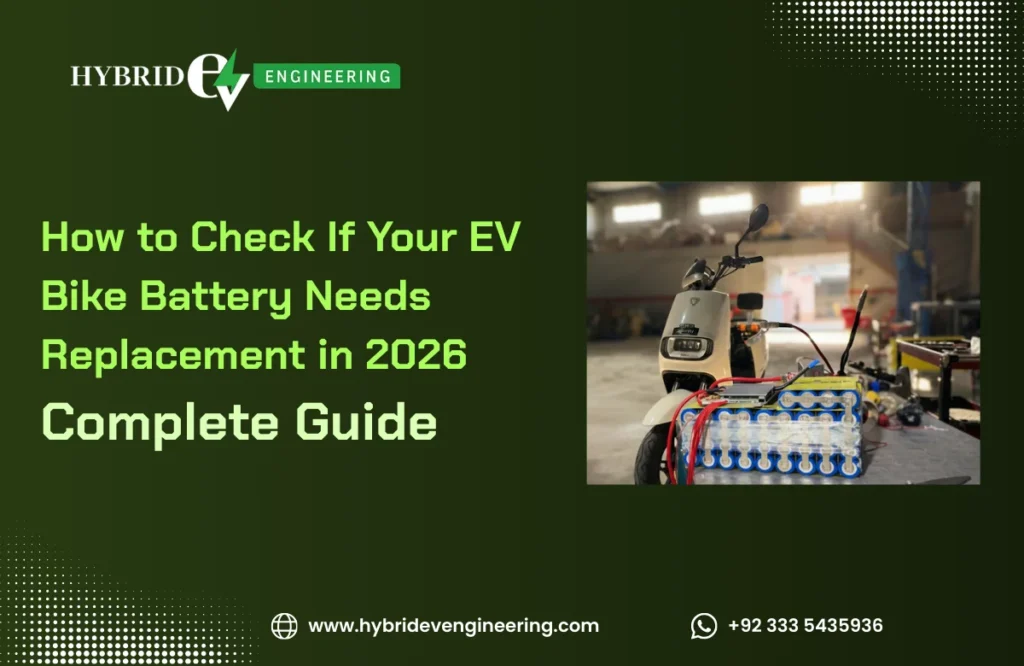
How to Check If Your EV Bike Battery Needs Replacement in 2026
Electric bikes are becoming very popular in Pakistan because they are economical, eco-friendly, and easy to maintain. But the most…
 EV Bike Batteries
Evee Electric Bike Battery Replacement Price in Pakistan
Your Evee was doing 80 kilometres on a charge when you bought it. Now it barely manages 40, and it…
 EV Bike Batteries
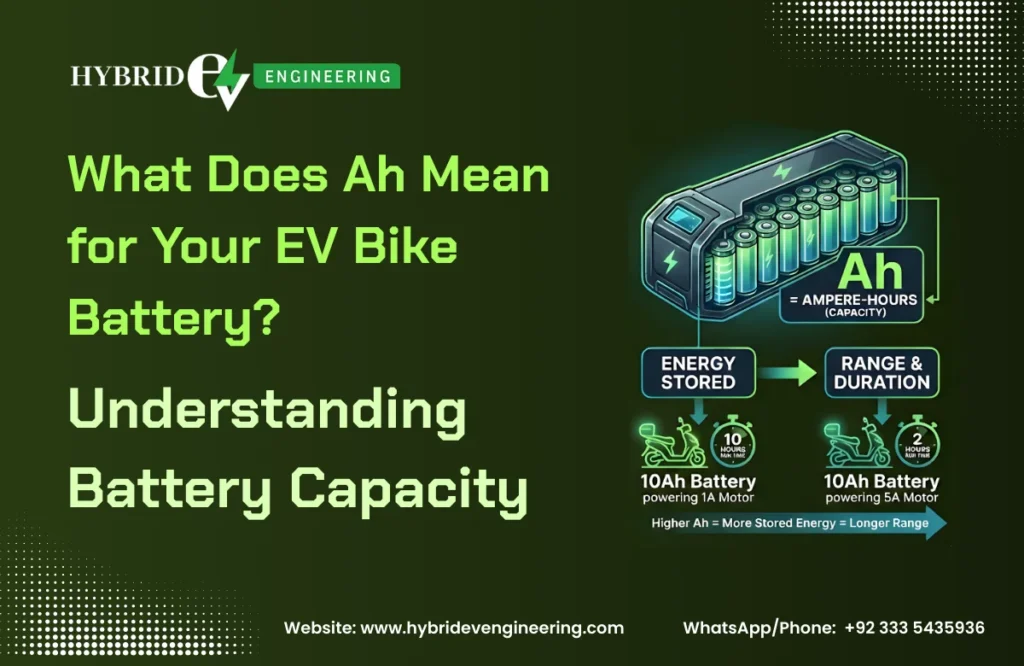
Understanding Battery Capacity | What Does Ah Mean for Your EV Bike?
When buying an electric bike or upgrading your battery, one of the biggest confusions people have is about Ah (Ampere-hour).…