
How to Choose the Right Lithium Battery for Your Jolta Bike

Jolta electric bikes have become one of the most popular EV choices in Pakistan. They are affordable, practical, and perfect for daily commuting. But if you own a Jolta, you have probably realized that the stock lead acid battery does not deliver the performance you expected.
The good news? Upgrading to a lithium battery can completely transform your Jolta’s performance. The challenge? Choosing the right lithium battery from the many options available.
This guide will help you understand exactly what battery your Jolta needs, how to choose the right capacity, and what to look for when making your purchase.
Understanding Your Jolta Electric Bike
Before choosing a battery, you need to understand what your Jolta requires. Different Jolta models have different specifications, and choosing the wrong battery can damage your bike or deliver poor performance.
Common Jolta Models in Pakistan
Jolta offers several electric bike models, each with slightly different power requirements:
- Jolta Electric JE-70: Entry level model with 800W to 1000W motor
- Jolta Electric JE-100: Mid range model with 1000W to 1200W motor
- Jolta Electric JE-125: Higher power model with 1200W to 1500W motor
- Jolta Electric Scooter: Scooter style with varying motor sizes
Most Jolta bikes come with either 60V or 72V electrical systems. This voltage is the most important specification you need to know before buying a replacement battery.
Lithium Batteries for Jolta Electric Bikes
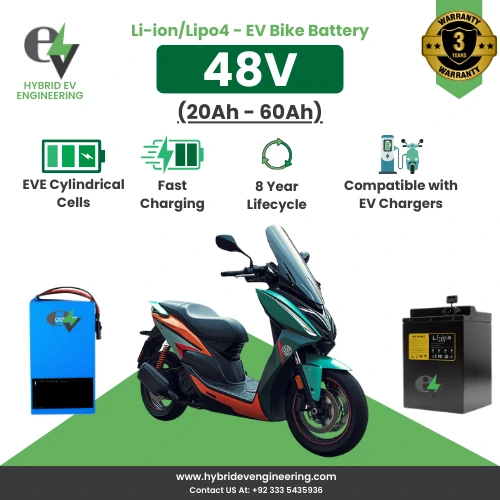
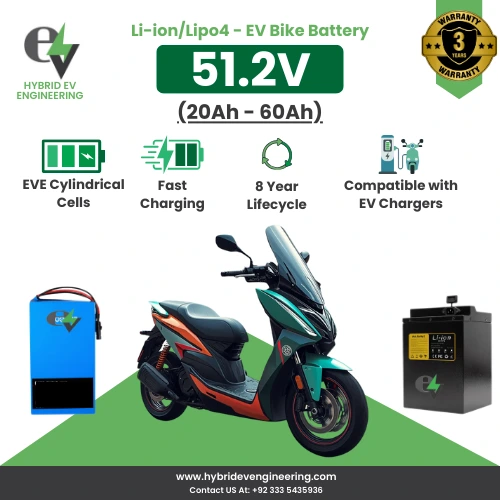
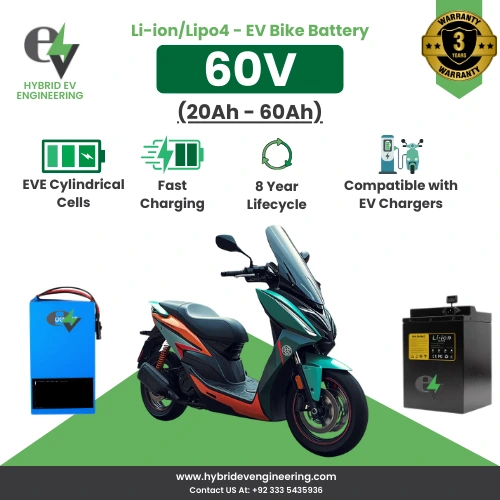
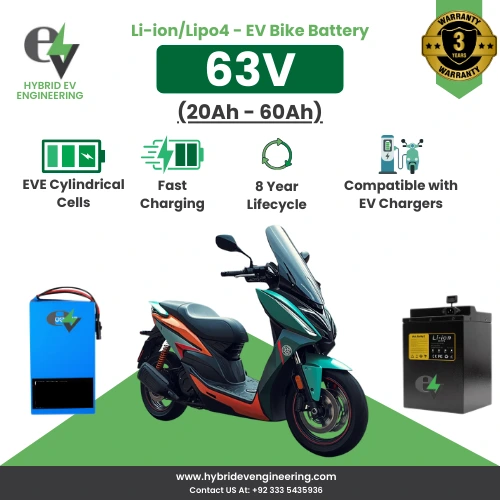
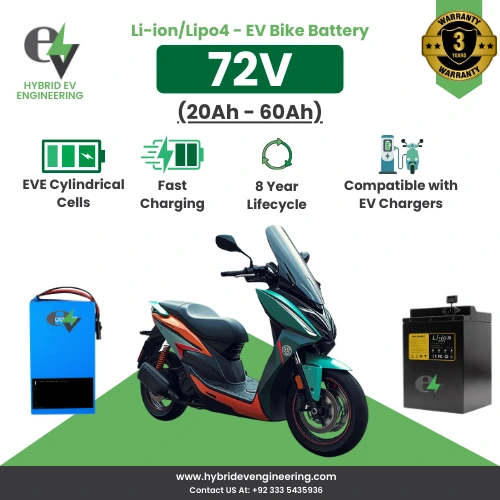
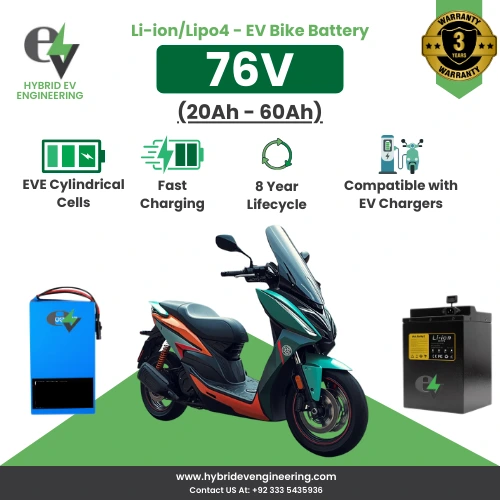
We offer a complete range of lithium batteries designed specifically for electric bikes like Jolta. All our batteries feature EVE cylindrical cells, quality BMS protection, 8 year lifecycle, fast charging capability, and compatibility with standard EV chargers.
Why Upgrade Your Jolta to Lithium?
Your Jolta came with a lead acid or gel battery. These batteries are cheap to manufacture, which keeps the bike price low. But they come with serious limitations that affect your daily riding experience.
Problems You Are Probably Experiencing
If you have been riding your Jolta for a few months, you likely recognize these issues:
- Shrinking range: The 60 to 70 km range promised when new has dropped to 30 to 40 km
- Weak acceleration: The bike feels sluggish, especially when starting or climbing
- Long charging times: You wait 8 to 10 hours for a full charge
- Summer problems: Performance drops dramatically in hot weather
- Heavy battery: The bike feels unnecessarily heavy and hard to handle
These are not problems with your Jolta. They are problems with lead acid battery technology. Lithium solves all of them.
Not sure if your battery needs replacement? Learn how to check if your EV bike battery needs replacement.
What Changes After Lithium Upgrade
| Aspect | Stock Lead Acid | After Lithium Upgrade |
|---|---|---|
| Actual Range | 30 to 40 km (after 6 months) | 60 to 100+ km (consistent) |
| Charging Time | 8 to 10 hours | 3 to 4 hours |
| Battery Weight | 35 to 45 kg | 12 to 18 kg |
| Acceleration | Weak, voltage sag under load | Strong, stable power delivery |
| Summer Performance | Degrades significantly | Stable up to 55°C |
| Expected Lifespan | 1 to 2 years | 6 to 8 years |
| Maintenance | Regular attention needed | Virtually none |
The difference is dramatic. Riders who upgrade their Jolta to lithium often say it feels like a completely new bike.
Key Factors for Choosing the Right Lithium Battery
Not all lithium batteries are the same. Choosing the right one for your Jolta requires understanding several key factors.
Factor 1: Voltage (Most Important)
Your battery voltage must match your Jolta’s electrical system exactly.
- 60V Jolta: Requires 60V or 63V lithium battery
- 72V Jolta: Requires 72V or 76V lithium battery
Using a higher voltage battery than your controller supports will damage your electronics. Using a lower voltage battery will result in poor performance or the bike not working at all.
Important: The slight voltage variations (60V vs 63V, 72V vs 76V) exist because lithium cells have different nominal voltages than lead acid. A 63V lithium pack is designed to work in a 60V system, and a 76V pack works in a 72V system.
Factor 2: Capacity (Ah Rating)
Capacity determines how far you can ride on a single charge. It is measured in Ampere-hours (Ah).
But here is what most sellers will not tell you: a 20Ah lithium battery delivers more actual range than a 30Ah lead acid battery. This is because lithium provides 90 to 95% usable capacity while lead acid only provides 50 to 60%.
Choosing the right capacity for your needs:
- 20Ah: Best for short daily commutes (10 to 15 km round trip)
- 30Ah: Ideal for typical city commuting (20 to 30 km daily)
- 40Ah: Good for longer commutes or occasional long trips (30 to 50 km daily)
- 60Ah: Best for heavy use, delivery work, or long distance riding
Think about your actual daily usage, not just maximum possible range. A larger battery costs more and weighs more. Choose what matches your real needs.
Factor 3: Cell Quality
The cells inside the battery pack determine its performance, safety, and lifespan. Not all lithium cells are equal.
What to look for:
- EVE cells: Excellent quality, 8 year lifecycle, widely trusted
- CATL cells: Premium quality, used in major EV brands
- Grade A cells: New, factory fresh cells with full capacity
What to avoid:
- Grade B cells: Factory rejects with defects
- Recycled cells: Used cells from old battery packs
- Unknown brands: Cells with no verifiable origin
Cheap batteries often use low quality or recycled cells. They may work initially but fail quickly and can be dangerous. Always ask about cell brand and grade before purchasing.
Factor 4: BMS (Battery Management System)
The BMS is the brain of your lithium battery. It protects against overcharge, overdischarge, overcurrent, and short circuits. A quality BMS is essential for safety and battery longevity.
Good BMS features:
- Overcharge protection (prevents fire risk)
- Overdischarge protection (prevents cell damage)
- Short circuit protection
- Temperature monitoring
- Cell balancing (keeps all cells at equal charge)
- Appropriate current rating for your motor
A battery with a poor quality or undersized BMS can fail, catch fire, or damage your cells prematurely. Never compromise on BMS quality.
Factor 5: Physical Fit
Your new battery must fit in your Jolta’s battery compartment. Measure your existing battery space before ordering:
- Length
- Width
- Height
- Connector type
A custom built battery can be designed to fit your exact space. This is better than trying to force a standard size battery into a space it was not designed for.
Detailed Pricing by Capacity
Here are detailed prices based on capacity for the most common Jolta voltage systems.
60V / 63V Lithium Batteries (For 60V Jolta Models)
| Capacity | Price (PKR) | Watt Hours | Expected Range | Best For |
|---|---|---|---|---|
| 20 Ah | 67,000 | 1,260 Wh | 40 to 50 km | Short daily commutes |
| 30 Ah | 105,000 | 1,890 Wh | 60 to 75 km | Medium commutes |
| 40 Ah | 125,000 | 2,520 Wh | 80 to 95 km | Longer distances |
| 60 Ah | 183,000 | 3,780 Wh | 120 to 145 km | Delivery and commercial |
72V / 76V Lithium Batteries (For 72V Jolta Models)
| Capacity | Price (PKR) | Watt Hours | Expected Range | Best For |
|---|---|---|---|---|
| 20 Ah | 79,000 | 1,520 Wh | 48 to 58 km | Short daily commutes |
| 30 Ah | 115,000 | 2,280 Wh | 72 to 87 km | Medium commutes |
| 40 Ah | 149,000 | 3,040 Wh | 96 to 115 km | Longer distances |
| 60 Ah | 219,000 | 4,560 Wh | 144 to 173 km | Delivery and commercial |
How to Calculate the Right Battery Size for Your Needs
Choosing the right capacity is not about getting the biggest battery. It is about matching your actual usage. Here is how to calculate what you need.
Step 1: Determine Your Daily Distance
Think about your typical daily riding:
- Distance to work or school
- Return journey
- Any additional stops or errands
- Weekend usage patterns
Add these up to get your average daily distance. Most Jolta owners in Pakistani cities ride 15 to 30 km daily.
Step 2: Add Safety Buffer
Never plan to use 100% of your battery capacity every day. Add a 30 to 40% buffer for:
- Unexpected detours
- Battery degradation over time
- Hot weather reducing efficiency
- Occasional longer trips
If you ride 25 km daily, plan for a battery that provides at least 35 to 40 km comfortable range.
Step 3: Match to Available Options
Using the tables above, find a battery that provides your calculated range with some margin.
Example:
- Daily commute: 20 km
- With 40% buffer: 28 km minimum range needed
- For a 72V Jolta: 20Ah battery provides 48 to 58 km
- Recommendation: 20Ah is sufficient with good margin
Do not overbuy. A 60Ah battery for a 20 km daily commute is unnecessary expense and extra weight.
Common Mistakes to Avoid
We see Jolta owners make these mistakes when buying lithium batteries. Avoid them to save money and frustration.
Mistake 1: Buying Based on Price Alone
The cheapest lithium battery is rarely the best value. Low prices usually mean:
- Low quality or recycled cells
- Undersized or poor quality BMS
- No proper warranty
- Shorter lifespan
A cheap battery that fails in 2 years costs more than a quality battery that lasts 6 to 8 years.
Mistake 2: Wrong Voltage
Installing a 72V battery in a 60V Jolta will damage your controller and possibly your motor. Always verify your voltage requirement before ordering.
Mistake 3: Ignoring Physical Dimensions
A battery that does not fit your compartment creates problems. It may require modifications, improper mounting, or blocked ventilation. Measure first, then order.
Mistake 4: DIY Installation Without Knowledge
Lithium batteries are safe when properly handled, but incorrect installation can create hazards. If you are not experienced with electrical systems, professional installation is worth the cost.
Mistake 5: No Warranty
A lithium battery is a significant investment. Never buy without proper warranty coverage. Legitimate sellers stand behind their products.
Frequently Asked Questions
Will a lithium battery work with my Jolta’s existing charger?
In most cases, if the voltage matches, your existing charger will work. However, lithium batteries charge more efficiently with a lithium-specific charger. We can provide a compatible charger if needed.
Is lithium safe for my Jolta?
Yes. We use LiFePO4 (Lithium Iron Phosphate) chemistry, which is the safest lithium technology available. Unlike other lithium types, LiFePO4 does not catch fire or explode even when damaged. Combined with a quality BMS, these batteries are actually safer than lead acid.
How long will a lithium battery last in my Jolta?
With proper use, expect 6 to 8 years or 2000 to 4000 charge cycles. This is 4 to 6 times longer than lead acid batteries.
Can I install the battery myself?
If you are comfortable with basic electrical work, installation is straightforward. The battery uses the same connectors as your original. However, we recommend professional installation if you are unsure.
Will upgrading to lithium void my Jolta warranty?
Battery replacement does not affect motor or controller warranties. The new battery comes with its own warranty from us.
What if my battery compartment is a different size?
We can build custom batteries to fit your exact compartment dimensions. Contact us with your measurements for a custom quote.
Why Jolta Owners Choose Us
At Hybrid EV Engineering, we have helped hundreds of Jolta owners upgrade to lithium. Here is why they trust us:
- Quality cells: We use only EVE Grade A cylindrical cells with 8 year lifecycle
- Proper BMS: Every battery includes correctly rated BMS with full protection
- Custom builds: We can design batteries to fit any Jolta model
- Warranty: Full warranty coverage on all our batteries
- Expert support: Free consultation to help you choose the right battery
- Professional installation: Available at our workshop in Islamabad
Learn more about our EV bike battery services.
Making Your Decision
Choosing the right lithium battery for your Jolta comes down to:
- Correct voltage: Match your bike’s electrical system (60V or 72V)
- Right capacity: Based on your actual daily usage plus buffer
- Quality cells: EVE or equivalent Grade A cells
- Good BMS: Full protection features, correctly rated
- Proper fit: Dimensions that match your compartment
- Warranty: Protection for your investment
If you check all these boxes, you will have a lithium battery that transforms your Jolta and serves you reliably for years.
Ready to Upgrade Your Jolta?
Still unsure which battery is right for your Jolta? We are here to help.
Contact us for a free consultation. Tell us your Jolta model, your daily usage, and your budget. We will recommend the perfect battery for your needs.
Do not settle for poor range and sluggish performance. Upgrade your Jolta to lithium and experience what your bike was meant to deliver.
Get Free Battery Recommendation for Your Jolta
 EV Bike Batteries
Yadea Electric Scooty Battery Price in Pakistan: 2026 Buying Guide
Yadea electric scooty battery price in Pakistan starts from Rs 56,000 for a 48V 20Ah lithium pack. Compare voltages, range and lifespan before you buy.
EV Bike Batteries
Can You Upgrade Your Lead Acid EV Bike to Lithium? Step-by-Step Guide
If you own an electric bike in Pakistan with a lead acid or gel battery, you have probably noticed the…
 EV Bike Batteries
Complete Guide to EV Bike Batteries in Pakistan: Prices, Types & Where to Buy in 2026
If you own an electric bike or scooty in Pakistan, you already know that the battery is the heart of…