

Custom High Voltage Battery 90V–1000V: Build Guide for Pakistan
A step-by-step guide to specifying, building and installing a custom high voltage battery 90V–1000V in Pakistan, from voltage matching to load testing and delivery.

You have a machine, a solar setup or a traction system that needs more than a 48V pack can give. The inverter or controller says 96V, 192V or higher, and the load is heavy enough that low-voltage just means thick cables and heat.
A custom high voltage battery 90V–1000V is built around your equipment, not pulled off a shelf. That means the voltage, capacity and BMS current are chosen to match what you already own.
This guide walks through the whole process: chemistry choice, voltage and capacity selection, what to send on WhatsApp, how the pack is built and tested, and the mistakes that cost people money.
Quick answer
How do I order a custom high voltage battery 90V–1000V in Pakistan?
To order a custom high voltage battery 90V–1000V in Pakistan, send your inverter or controller voltage, required kWh, continuous load in kW and site location on WhatsApp. The pack is built in LiFePO4 or NMC, load tested, and delivered nationwide. Custom packs start at Rs 600,000, checked October 2026.
What does a custom high voltage battery 90V–1000V mean in practice?
A custom high voltage battery 90V–1000V is a built-to-order pack that runs from 90V DC up to 1000V DC, sized in kWh and current for your specific inverter, motor controller or charger. It is not a standard product with a fixed part number.
At these voltages, the same power moves with much less current. A 30kW load at 48V pulls over 600A. At 400V it pulls about 75A. That difference decides cable size, heat and inverter efficiency.
This is why high voltage lithium battery systems are used above roughly 20kW to 30kW of continuous load. Below that, a 48V or 51.2V pack is usually simpler and cheaper.
Which applications need 90V–1000V instead of a 48V pack?
You need high voltage when your load is heavy, your cable run is long, or your equipment already specifies a high DC bus. Common cases in Pakistan:
- Industrial energy storage: factory backup, tube well and mill loads above 20kW.
- Commercial solar with high-voltage inverters: three-phase hybrid inverters that expect a 200V–800V battery bus.
- Heavy machinery and traction: forklifts, industrial carts, custom EV platforms.
- Telecom and data sites: where rack space is tight and current must stay low.
If your load is a home, a shop or an e-bike, a 48V to 76V pack is the right answer. See the High Voltage Battery category for the full range, and the Lithium Solar Battery range for smaller solar setups.
LiFePO4 or NMC: which cell chemistry fits your load profile?
LiFePO4 is the safer, longer-life choice for daily cycling and hot sites. NMC gives more energy in the same space and weight, which matters on mobile equipment. Pick by duty cycle and space, not by price alone.
| Factor | LiFePO4 | NMC |
|---|---|---|
| Cycle life | Longer, suited to daily cycling | Shorter than LiFePO4 |
| Heat tolerance | More stable in Pakistani summer | Needs better thermal management |
| Energy per kg | Lower | Higher |
| Best for | Stationary storage, solar, plant backup | Mobile machinery, traction, tight spaces |
| Safety profile | More thermally stable | Requires stricter BMS control |
For a rooftop or ground-mount solar site in Multan or Karachi, LiFePO4 is usually the right call. For a machine that has to move and has limited battery space, NMC often wins. The build team confirms the chemistry after seeing your load profile.
How is voltage, capacity and BMS current chosen for your system?
Voltage is set by your inverter or controller. Capacity is set by how long you need to run. BMS current is set by your continuous and peak load. All three are locked together before any cells are ordered.
- Voltage: match the DC bus of your inverter or controller. If it says 192V nominal, the pack is built to that nominal.
- Capacity in kWh: multiply your average load in kW by the hours you need. Add margin for depth of discharge and ageing.
- BMS continuous current: take your continuous load in kW, divide by pack voltage, then add headroom for surge.
- Peak current: note any motor start or surge, because the BMS must ride through it without tripping.
Every pack is load tested and its BMS checked before it leaves the workshop, so the current settings are verified against your numbers, not just on paper.
What information do you send on WhatsApp to get an accurate quote?
Send five things and you get a real number instead of a guess: nominal voltage, required kWh, continuous load in kW, peak load in kW, and site location. A photo of the inverter or controller nameplate helps most.
- Inverter or controller model and its DC voltage range.
- Required runtime and daily energy use in kWh.
- Continuous and peak load in kW.
- Indoor rack or outdoor cabinet, and available space.
- City, so delivery time and site conditions can be factored in.
Custom high voltage battery 90V–1000V pricing is configuration-based, so the quote changes with voltage, capacity and cabinet type. A budgetary estimate is given first, then confirmed after the equipment is verified.
Send your load details, get a configured quote
Share your inverter or controller voltage, required kWh, continuous and peak load in kW, and your city. You get back a budgetary price, the recommended chemistry and a build timeline.
How is the pack built, load tested and BMS checked before delivery?
Cells are matched, laser welded into modules, then assembled into a rack or cabinet with a master-slave BMS. Before dispatch, the pack is load tested and the BMS communication and protection settings are verified.
Installation, delivery time and warranty across Pakistan
Packs are built at the I-9/3 Islamabad workshop and delivered nationwide in safe packaging. Delivery is same-day or next-day in Islamabad and Rawalpindi, 2 to 3 business days in major cities, and 3 to 5 business days elsewhere.
For high voltage systems, installation is normally done by your site electrician with our wiring guidance, because the DC bus, breaker and earthing must match the existing plant. Commissioning checks are shared before the pack is energised.
Custom packs carry a 5-year warranty on the build. Keep the invoice for any claim. Free battery health diagnosis is available at the Islamabad workshop.
Common mistakes when ordering a custom high voltage battery
Most problems come from incomplete information, not from the cells. These are the mistakes that delay a build or damage a pack.
How much does a custom high voltage LiFePO4 battery cost in Pakistan?
Custom high voltage battery systems start at Rs 600,000, checked October 2026, and rise with voltage, kWh and cabinet type. There is no single list price because every pack is configured.
Three things move the price most: total kWh, cell chemistry, and whether the pack needs an indoor rack or an IP54 outdoor cabinet. A higher voltage at the same kWh does not automatically cost much more, because the cells are the same; the BMS and insulation work change.
For comparison, smaller lithium packs for two-wheelers and home solar sit far below this range. See EV Bike Battery options if your load is under 20kW.
To get a firm number, configure the pack and send the spec to the engineering team. The final price is confirmed after the equipment is verified.
Frequently Asked Questions
How much does a custom high voltage LiFePO4 battery cost in Pakistan?
Custom high voltage LiFePO4 packs start at Rs 600,000, checked October 2026. The final price depends on voltage, total kWh, cell chemistry and whether the pack uses an indoor rack or an IP54 outdoor cabinet. Because each pack is built around your inverter or controller, you get a budgetary estimate first and a confirmed price after your equipment is verified.
How do I safely disconnect a high voltage battery?
Shut down the inverter or controller first, then open the DC breaker and confirm zero voltage at the terminals with a rated meter before touching any cable. High voltage DC can arc and does not self-extinguish like AC. Use insulated tools, follow the pack’s isolation procedure, and let a qualified electrician handle the disconnect if you are not trained for DC work.
What is a custom high voltage battery 90V–1000V used for?
It is used where a 48V pack cannot carry the load: industrial and factory backup, commercial solar with high-voltage inverters, heavy machinery and traction, forklifts, and telecom or data sites. These systems run above roughly 20kW to 30kW of continuous power, where higher voltage keeps current, cable size and heat under control.
Can you build a custom high voltage LiFePO4 battery for industrial energy storage in Pakistan?
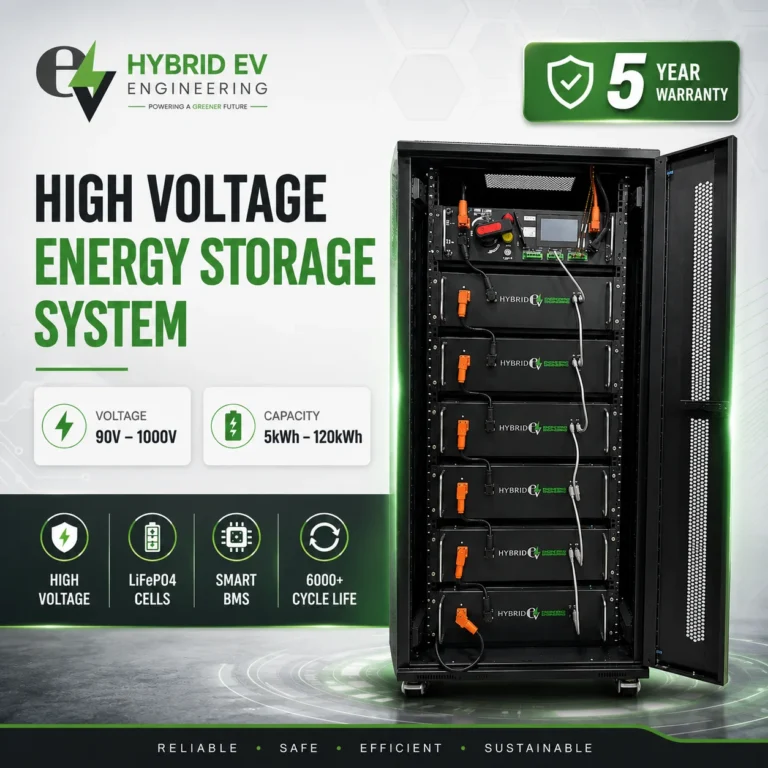
Yes. Packs are built in Pakistan from 90V to 1000V DC and 5kWh to 120kWh, in LiFePO4 or NMC, with a smart master-slave BMS using CAN and RS485. Each unit is engineered around your inverter, controller or charger, then load tested and its BMS checked before it leaves the workshop. Indoor rack and IP54 outdoor cabinet options are available.
How much does a custom high voltage battery system cost?
There is no single price because the system is priced by configuration. Voltage, total kWh, chemistry, BMS current rating and cabinet type all affect the total. Custom high voltage battery systems start at Rs 600,000, checked October 2026. Send your load details for a budgetary estimate, then a confirmed quote once the equipment is verified.
How long does delivery take for a high voltage battery in Pakistan?
Delivery is same-day or next-day in Islamabad and Rawalpindi, 2 to 3 business days in major cities, and 3 to 5 business days elsewhere in Pakistan. Packs are shipped in safe packaging. Build time depends on the configuration, so confirm the timeline with the team when you place the order.
Final Thoughts
The short version:
- High voltage is for loads above roughly 20kW to 30kW, where low voltage means thick cables and heat.
- Voltage comes from your inverter or controller; kWh comes from your runtime; BMS current comes from your peak load.
- LiFePO4 for daily cycling and hot sites, NMC for mobile equipment and tight spaces.
- Send voltage, kWh, continuous and peak kW, space and city on WhatsApp to get a real quote.
- Custom packs start at Rs 600,000, checked October 2026, and carry a 5-year warranty.
- Every pack is load tested and its BMS checked before delivery.
If you are still deciding between a low-voltage and high-voltage setup, the high voltage battery guide explains where each one fits. When you are ready, use the WhatsApp box below and send your load details.
Get Your Battery Quote
 Lithium Solar Batteries
High Voltage Battery: What It Is and Where It Is Used
A high voltage battery moves the same power at lower current, so cables run cooler and inverters stay efficient. Learn what it is, how it differs from low voltage, and where 90V to 1000V packs are used.
Lithium Solar Batteries
Best Lithium Solar Battery for Home in Pakistan: 2026 Guide
Solar power adoption in Pakistan is growing rapidly. Rising electricity costs, frequent load shedding, and increasing awareness of clean energy…
 Lithium Solar Batteries
Electric Fork Lifter Battery: Complete Guide
An electric fork lifter battery is the primary power source that allows an electric forklift to move, lift, and perform…