

Toyota Hybrid Battery Problems: Codes, Causes and Fixes

Hybrid vehicles have revolutionized the automotive industry by providing fuel efficiency and lower emissions. Toyota has been a pioneer in hybrid technology, offering models such as Prius, Aqua, Axio, Fielder, Yaris, Sienta, and Lexus CT200h in markets like Japan, the UK, and Pakistan.
However, hybrid batteries eventually degrade over time, leading to performance issues and diagnostic trouble codes (DTCs) such as P0A80 and P3000. Understanding these issues can help you take timely action and avoid costly repairs.
Common Hybrid Battery Failure Codes and Their Causes
Toyota hybrid vehicles rely on high voltage battery packs composed of multiple cells arranged in series. Over time, some cells weaken, leading to voltage imbalances that trigger warning lights and fault codes.
P0A80: Replace Hybrid Battery Pack
This code appears when the battery management system detects a significant voltage imbalance between battery blocks. The system continuously monitors voltage differences and records a fault when the delta exceeds 1.2V for more than 30 seconds.
When you see this code, it typically means one or more battery modules have degraded significantly and the entire pack needs attention.
P3000: Battery Control System Malfunction
This code generally indicates a problem within the hybrid battery ECU or an abnormal voltage fluctuation affecting battery efficiency. It can be caused by:
- Weak or failing battery cells
- Battery management system faults
- Communication errors between battery ECU and main ECU
- Cooling system failures causing overheating
If your vehicle displays either of these codes, we recommend getting a professional hybrid battery diagnostic to identify the exact cause.
How Long Do Hybrid Batteries Last?
The lifespan of a hybrid battery depends on various factors including climate, driving habits, and maintenance.
| Region | Expected Lifespan | Key Factors |
|---|---|---|
| Japan | 8 to 10+ years | Controlled temperatures, quality fuel, regular maintenance |
| United Kingdom | 8 to 10+ years | Mild climate, good road conditions |
| Pakistan | 4 to 6 years | Extreme heat, variable fuel quality, road conditions |
As you can see, hybrid batteries in Pakistan tend to fail earlier compared to other regions. Understanding why this happens can help you take preventive measures.
Why Do Hybrid Batteries Fail Sooner in Pakistan?
Several factors contribute to the premature failure of hybrid batteries in Pakistan:
High Temperatures
Pakistani summers regularly exceed 45 to 50°C in many cities. Excessive heat accelerates battery degradation by increasing internal resistance and causing faster chemical breakdown of battery cells. This is the single biggest factor affecting hybrid battery life in Pakistan.
Poor Road Conditions
Frequent bumps, potholes, and vibrations can lead to physical stress on battery cells. Over time, this causes loose connections, damaged modules, and premature wear that would not occur on smoother roads.
Irregular Charging Cycles
Inconsistent driving patterns and prolonged idling can prevent proper charge cycling. Stop and go traffic in Pakistani cities often keeps batteries in suboptimal charge states, affecting long term efficiency and health.
Lack of Maintenance
Many hybrid owners in Pakistan neglect regular battery health checks and cooling system cleaning. A clogged cooling fan or blocked air vents can cause overheating and accelerate cell failures. Simple maintenance can significantly extend battery life.
Battery Configuration in Toyota Hybrid Models
Each Toyota hybrid model has a unique battery configuration that affects performance and lifespan. Understanding your vehicle’s configuration helps in diagnosing issues accurately.
| Model | Total Cells | Block Configuration | Voltage per Block |
|---|---|---|---|
| Prius (3rd and 4th Gen) | 28 | 14 blocks | 14.4V |
| Lexus CT200h | 28 | 14 blocks | 14.4V |
| Toyota Aqua | 20 | 10 blocks | 14.4V |
| Prius C | 20 | 10 blocks | 14.4V |
| Toyota Axio | 20 | 10 blocks | 14.4V |
| Toyota Fielder | 20 | 10 blocks | 14.4V |
| Toyota Yaris Hybrid | 20 | 10 blocks | 14.4V |
| Toyota Sienta | 20 | 10 blocks | 14.4V |
When a weak cell causes a voltage drop beyond an acceptable limit, the vehicle registers an error code and prevents effective use of battery power. If the delta state of charge (SOC) increases beyond 30%, the vehicle disables hybrid mode entirely, requiring immediate servicing.
How to Diagnose Hybrid Battery Issues
If you suspect your hybrid battery is failing, follow these diagnostic steps:
Step 1: Scan for Trouble Codes
Use an OBD-II scanner capable of reading hybrid system codes. Look specifically for P0A80, P3000, and related codes. These provide the first indication of what is happening inside the battery pack.
Step 2: Perform Voltage Testing
Measure individual block voltages to identify weak cells causing imbalance. A healthy battery pack should show minimal voltage differences between blocks (less than 0.3V). Differences greater than 1.0V indicate failing modules.
Step 3: Check the Cooling System
Ensure the battery cooling fan is working properly and air vents are clean. A clogged cooling system is one of the most common causes of premature battery failure in Pakistan. Clean the fan and vents every 6 months as preventive maintenance.
Step 4: Evaluate Replacement Options
Based on diagnostic results, you may need battery reconditioning or complete replacement. Minor imbalances can sometimes be corrected, but severely degraded cells require module or pack replacement.
Signs Your Hybrid Battery Needs Attention
Watch for these warning signs that indicate your hybrid battery may be failing:
- Check engine light or hybrid system warning light illuminated
- Reduced fuel economy compared to normal
- Engine running more frequently than usual
- Reduced power or sluggish acceleration
- Battery charge fluctuates rapidly
- Air conditioning performance drops at idle
- Vehicle struggles to start or takes longer to ready
If you notice any of these symptoms, do not ignore them. Early diagnosis can often save you from more expensive repairs later.
Preventing Premature Battery Failure
While hybrid batteries will eventually need replacement, you can extend their lifespan with proper care:
- Clean the cooling fan every 6 months: Remove dust and debris that restricts airflow
- Park in shade when possible: Reduce heat exposure during hot summer months
- Drive regularly: Avoid leaving the vehicle unused for extended periods
- Get annual battery health checks: Catch problems early before they worsen
- Address warning lights immediately: Do not delay when codes appear
Professional Hybrid Battery Services
At Hybrid EV Engineering, we specialize in diagnosing and resolving hybrid battery issues for all Toyota and Lexus models. Our hybrid car battery services include:
- Complete battery health diagnostics
- Individual cell and block voltage testing
- Cooling system inspection and cleaning
- Battery reconditioning for minor issues
- Full battery replacement with warranty
- Lithium conversion upgrades
If your Toyota hybrid displays warning codes or shows signs of battery degradation, contact us for expert evaluation and solutions to extend battery life and restore vehicle efficiency.
Top 5 Tips for Buying New & Used Hybrid Batteries in Pakistan
Introduction When it comes to maintaining your hybrid vehicle, one of the most critical components is the Hybrid Battery. Whether…
 Hybrid Battery
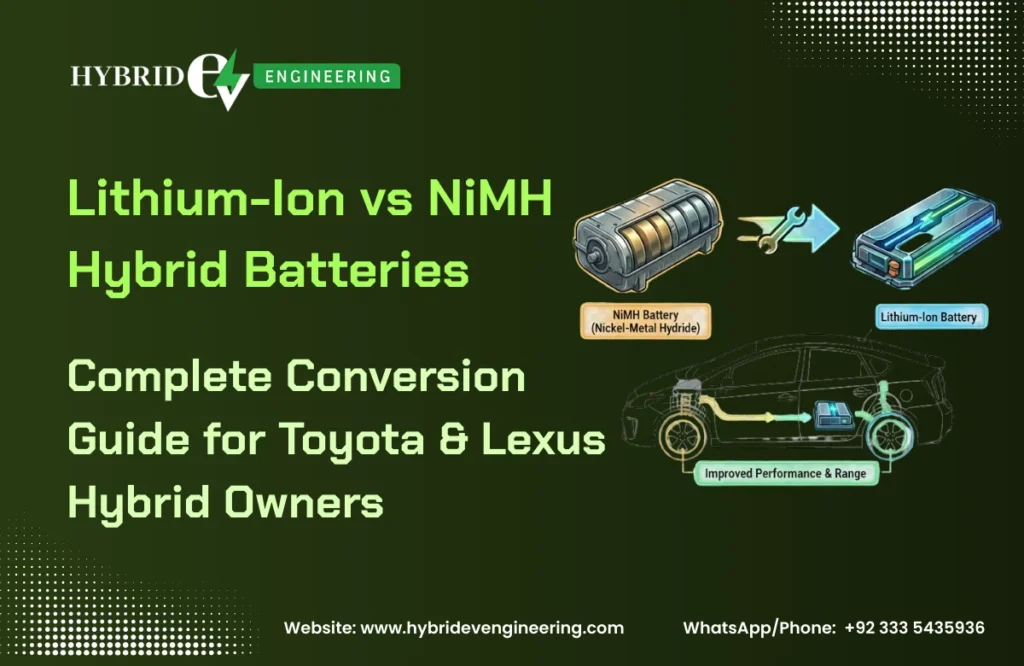
Lithium-Ion vs NiMH Hybrid Batteries | Complete Conversion Guide for Toyota & Lexus Hybrid Owners
Hybrid vehicles from Toyota and Lexus are now common across Pakistan. Whether you are searching for a hybrid battery in…
 Hybrid Battery
How Long Do Best Hybrid Battery Last? (2026 Update)
If you own a hybrid car in Pakistan, one question sits at the back of your mind: how long will…