
60V Lithium Battery for EV Bike in Pakistan: Buyer’s Guide
A 60V lithium battery for EV bike in Pakistan starts at Rs 67,000. This guide shows how to match voltage to your controller, choose the right Ah for your daily km, and avoid the mistakes that kill controllers.

Your EV bike still runs, but the range is shrinking. A ride that used to take you across town now needs a charge halfway. In summer the pack gets hot, the charger runs longer, and you start wondering whether the motor or the battery is the problem.
Most of the time it is the battery. And if your bike is a 60V model, the replacement decision is simpler than it looks once you know three things: what voltage your controller actually accepts, how many km you ride in a day, and what a real lithium pack costs here.
This guide settles all three. It covers 60V and 63V matching, LiFePO4 versus Li-ion in Pakistani heat, capacity choices from 20Ah to 60Ah, fitment, BMS protection, prices checked in October 2026, and what warranty and delivery you should expect.
Quick answer
What should I know before buying a 60V lithium battery for an EV bike in Pakistan?
A 60V lithium battery for EV bike in Pakistan must match your controller’s voltage, so a 60V bike takes a 60V pack, or 63V only where the controller allows it. Then pick capacity by daily km: 20Ah for short city rides up to 60Ah for long daily runs. Prices start at Rs 67,000.
Why 60V is the most common EV bike voltage in Pakistan
60V sits in the middle of the EV bike market here, and that is exactly why it is so common. It gives noticeably better torque and top speed than a 48V setup without the cost and controller stress of a 72V system. Most mid-range electric bikes and scooties sold in Pakistan run on it.
You will see it across the Evee 60V class, which includes the Nisa, GEN-Z, LX and Sqube, most of which ship with a 60V 32Ah graphene pack. Most Jolta bikes also run 60V or 72V systems. When those original graphene packs reach the end of their life, usually after two to three years in our summers, riders come looking for a lithium replacement.
Lithium changes the maths. A lead acid or graphene pack manages roughly 300 to 500 charge cycles. A lithium pack with EVE cylindrical cells is rated up to 4000 cycles and can last up to 8 years with proper charging. That is the real reason 60V lithium has become the default upgrade.
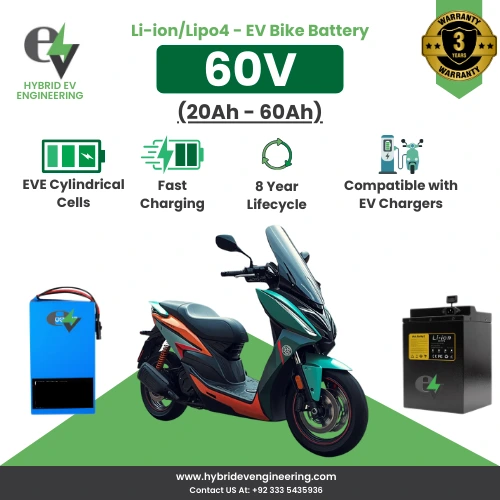
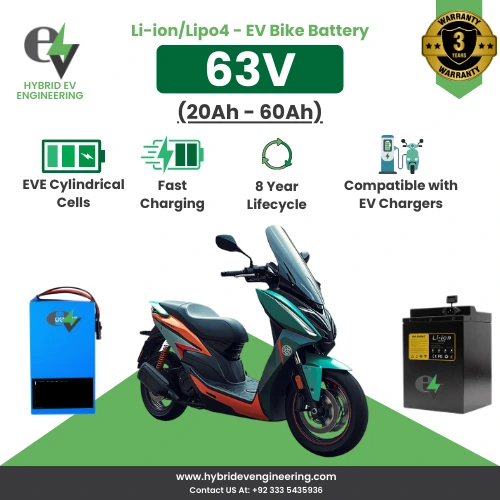
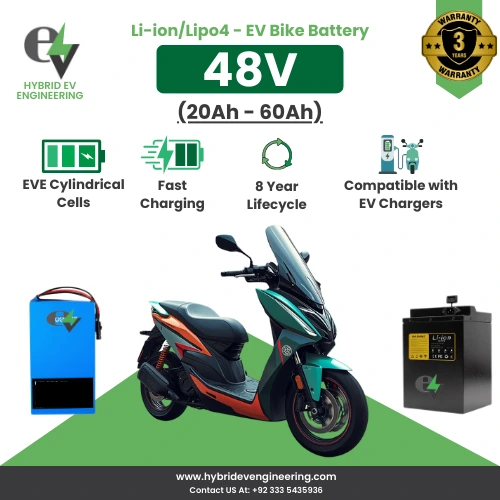
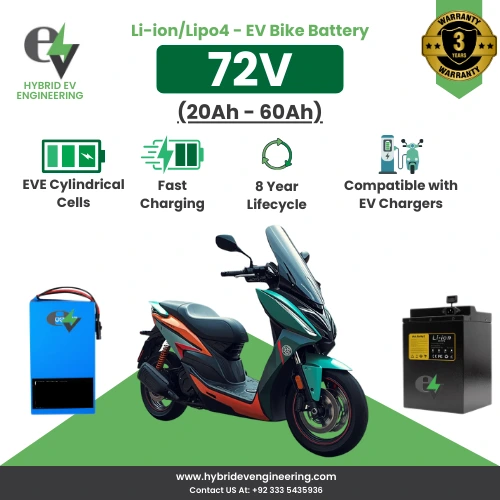
If you are still deciding between voltages, the full EV Bike Battery range lists every option in one place. The 60V pack itself comes in 20Ah, 30Ah, 40Ah and 60Ah, priced from Rs 67,000 as checked in October 2026.
How do I know my bike needs a 60V battery and not 63V?
Check the label on your controller and your old charger. If both say 60V, buy a 60V pack. A 63V pack is only safe where the controller is rated to accept it, because the higher nominal voltage pushes more current through the same wiring and FETs.
Voltage matching is the single most important rule in this whole guide. A 60V bike takes a 60V pack, or 63V where the controller allows it. A 72V bike takes a 72V pack, or 76V where the controller allows it. Get this wrong in the upward direction and you can damage the controller. Get it wrong downward and the bike will feel weak or refuse to start.
- Look at the controller sticker first. It usually states nominal voltage and a cut-off range.
- Check the charger output. A 60V charger and a 63V charger are not interchangeable.
- Do not guess from the old pack’s label alone. Graphene and lead acid packs are labelled differently from lithium.
A 63V pack is a genuine option for riders who want a little more torque and controller efficiency without jumping to 72V. It is not an upgrade you apply blindly. If you are unsure, send a photo of the controller label on WhatsApp and we will confirm before you pay.
LiFePO4 vs Li-ion for 60V EV bikes: which lasts longer in Pakistani heat?
Both chemistries work in a 60V EV bike, and both are built here with EVE cylindrical cells. LiFePO4 handles heat and being left at full charge a little better. Li-ion is lighter and usually gives more range for the same weight. For most daily riders in Lahore, Karachi or Islamabad, a well-built pack of either type with a good BMS will serve for years.
The bigger factor is not the chemistry label. It is how the pack is built and how you treat it. A cheap pack with mismatched cells and a weak BMS will fail in the heat whether it says LiFePO4 or Li-ion. A properly built pack with a smart BMS that balances cells and cuts off on temperature will keep going.
- Park in shade. Do not leave the bike in direct sun for hours with a full pack in peak summer.
- Charge in the cooler part of the day. Charging a hot pack straight after a long ride adds stress.
- Do not store at full charge for weeks. If you are away, leave the pack part-charged.
Our packs use EVE cylindrical cells in both chemistries, with a smart BMS that protects against over-charging, deep discharge, over-current, short circuits and thermal imbalance. That protection matters more in a Pakistani summer than the chemistry name on the box.
What Ah capacity should I choose for daily commuting range?
Pick capacity by your real daily km, not by the biggest number you can afford. The 60V pack runs 40-50 km on 20Ah, 60-75 km on 30Ah, 80-95 km on 40Ah and 120-145 km on 60Ah. Those figures are realistic for normal city riding, not full throttle all day.
Be honest about your route. A rider doing 25 km a day in Faisalabad with one passenger and a few flyovers needs more than the km number suggests. Heat, load, tyre pressure and riding style all pull range down. In peak summer you will see noticeably less range than in winter, so leave yourself a margin.
How many km can an EV bike run on a 60V 30Ah lithium battery? Plan on roughly 60-75 km in normal conditions, and treat that as the upper end rather than a guarantee. If your daily ride is 50 km with a passenger, the 40Ah is the safer buy.
| Capacity | Range (km) | Price (PKR) | Best for |
|---|---|---|---|
| 20 Ah | 40-50 km | 67,000 | Short city commutes, single rider |
| 30 Ah | 60-75 km | 105,000 | Daily office or college run |
| 40 Ah | 80-95 km | 125,000 | Longer commutes, passenger load |
| 60 Ah | 120-145 km | 183,000 | Delivery riders, long daily distance |
Prices above are for the 60V Li-ion / LiFePO₄ EV Bike Battery (20Ah–60Ah) and were checked in October 2026. If your bike is a 48V model, the 48V pack starts at Rs 56,000 with shorter range figures.
Will a 60V lithium pack fit my bike’s battery compartment?
It should, because custom packs are built to the shape of your bike or scooty compartment at no extra charge for the custom shape at a given voltage and capacity. The connector and charge port are matched to your existing setup as well.
This matters more than most buyers expect. A generic rectangular pack may not slide into the under-seat bay of an Evee Nisa or the step-through compartment of a Sqube. Forcing it in can pinch wiring or leave the pack rattling, and vibration is hard on cells over time.
What to send us before the pack is built:
- A photo of the old battery in place, with the compartment open.
- The length, width and height of the bay, measured with a tape.
- A close-up of the connector and charge port.
- The bike model and the controller label.
With those four things we can build a pack that drops in and connects without adapters. Riders outside Islamabad get wiring guidance so the install is straightforward at their end.
How does the smart BMS protect my battery and controller?
The BMS is the brain of the pack. It watches cell voltage, current and temperature, balances the cells, and cuts the pack off before damage happens. A weak or missing BMS is the most common reason cheap lithium packs die early or take a controller with them.
Every pack here carries a smart BMS that protects against over-charging, deep discharge, over-current, short circuits and thermal imbalance. In practice that means the pack will not let you drain it to the point of permanent damage, and it will not let a faulty charger push it past safe limits.
Every pack is load tested and its BMS checked before it leaves the workshop. That test is why we ask for your controller details: the pack is verified against the setup it will actually run in.
What does a 60V lithium EV bike battery cost in Pakistan?
The 60V pack starts at Rs 67,000 for 20Ah and goes up to Rs 183,000 for 60Ah, as checked in October 2026. The 63V pack carries the same price table. That is a real jump over a graphene replacement, so it helps to compare it over the years rather than the day.
Look at the electric bike lithium battery price in Pakistan this way: a graphene pack costs less upfront but typically lasts two to three years and manages 300 to 500 cycles. A lithium pack is rated up to 4000 cycles and can last up to 8 years with proper charging. Spread over that life, the monthly cost is usually lower, and you spend far fewer evenings hunting for a charger.
For a broader picture of replacement costs on one popular brand, see our guide to Evee electric bike battery replacement price in Pakistan. If you ride a Jolta, the Jolta battery selection guide covers the 60V and 72V options.
Not sure which pack fits your bike?
Send your bike model, a photo of the controller label, the compartment measurements and your daily km on WhatsApp. You get back the right voltage, the right Ah, a confirmed price and a delivery estimate.
Which 60V option should you pick?
Match the voltage to the controller first, then pick capacity by daily km, then confirm the compartment size. Do it in that order and the choice becomes obvious.
For most readers on a 60V bike, the 30Ah is the sweet spot. It covers a normal daily commute with margin for summer heat and the occasional passenger. Delivery riders and anyone covering more than 80 km a day should go straight to the 40Ah or 60Ah. The custom fit guide for e bikes and scooties walks through the fitment side in more detail.
Warranty, installation and nationwide delivery explained
Every EV bike battery carries a 3-year warranty, and custom-built packs carry the same terms as standard packs. Installation is free at the I-9/3 Islamabad workshop, and packs ship nationwide in safe packaging.
Here is what that looks like in practice:
- Warranty: 3 years on every battery, custom shapes included.
- Installation: free professional fitting at Plot 315, Street 3, I-9/3 Industrial Area, Islamabad. There is also a branch on Old Airport Road, Rawalpindi.
- Delivery: same-day or next-day in Islamabad and Rawalpindi, 2-3 business days to major cities, 3-5 business days elsewhere.
- Outside Islamabad: wiring guidance is included so your local mechanic can fit the pack correctly.
- Diagnosis: free battery health check at the Islamabad workshop if you are unsure whether your current pack is failing.
Keep your invoice. It is what you show to claim warranty later. With 15+ years of experience and 5,000+ customers, the workshop has seen most of the failure patterns that show up on Pakistani roads, and a quick diagnosis often saves a replacement you did not need.
Frequently Asked Questions
Which lithium battery is best for an electric bike or scooty in Pakistan?
There is no single best pack. Match the voltage to your controller first, then choose capacity by daily km. For most 60V bikes, a 30Ah pack built with EVE cylindrical cells and a smart BMS is the practical choice. Riders covering long distances or carrying passengers should move up to 40Ah or 60Ah.
How many km can an EV bike run on a 60V 30Ah lithium battery?
Plan on roughly 60-75 km in normal city riding. That figure drops with a passenger, steep routes, low tyre pressure and peak summer heat. If your daily ride is close to 60 km, choose the 40Ah pack so you are not charging twice a day.
Can I use a 63V battery in a 60V e-bike controller?
Only if the controller is rated to accept it. A 63V pack is a higher nominal voltage and pushes more current through the same wiring and controller components. Check the controller label and charger output before ordering. If the label says 60V only, stay with a 60V pack.
How do I charge a 63V lithium e-bike battery safely?
Use the charger matched to the pack, charge in shade or a cool room, and avoid charging straight after a long ride while the pack is hot. Do not leave it plugged in for days. The smart BMS stops over-charging, but good habits still extend pack life in Pakistani summers.
How many km can a 60V 30Ah lithium battery run an e-scooty?
Expect about 60-75 km in mixed city use, similar to an EV bike on the same pack. Scooties with smaller wheels and heavier riders often land at the lower end. Treat the figure as a range, not a promise, and leave a margin for summer.
What is the electric bike lithium battery price in Pakistan?
For the 60V pack, prices run from Rs 67,000 for 20Ah to Rs 183,000 for 60Ah, checked in October 2026. The 48V range starts at Rs 56,000. Custom shapes at a given voltage and capacity carry no extra charge.
Final Thoughts
The short version:
- Match voltage to the controller: 60V for a 60V bike, 63V only where the controller allows it.
- Pick capacity by real daily km, not by the biggest number on the price list.
- LiFePO4 and Li-ion both work here; the build quality and BMS matter more than the chemistry label.
- A 60V pack starts at Rs 67,000 for 20Ah and reaches Rs 183,000 for 60Ah, checked in October 2026.
- Custom shapes, connector matching, a 3-year warranty and free installation in Islamabad are included.
- Send your bike model and controller photo before ordering so the pack is built right the first time.
If you are still weighing a 48V bike against a 60V one, our e bike and scooty battery guide covers both. Otherwise, use the WhatsApp box below and we will confirm what fits your bike.
Get Your Battery Quote
 EV Bike Batteries
United Electric Bike Battery Price in Pakistan: 2026 Guide
A practical guide to United electric bike battery price in Pakistan, with real 2026 prices for 48V to 76V lithium packs, range estimates and buying advice.
 EV Bike Batteries
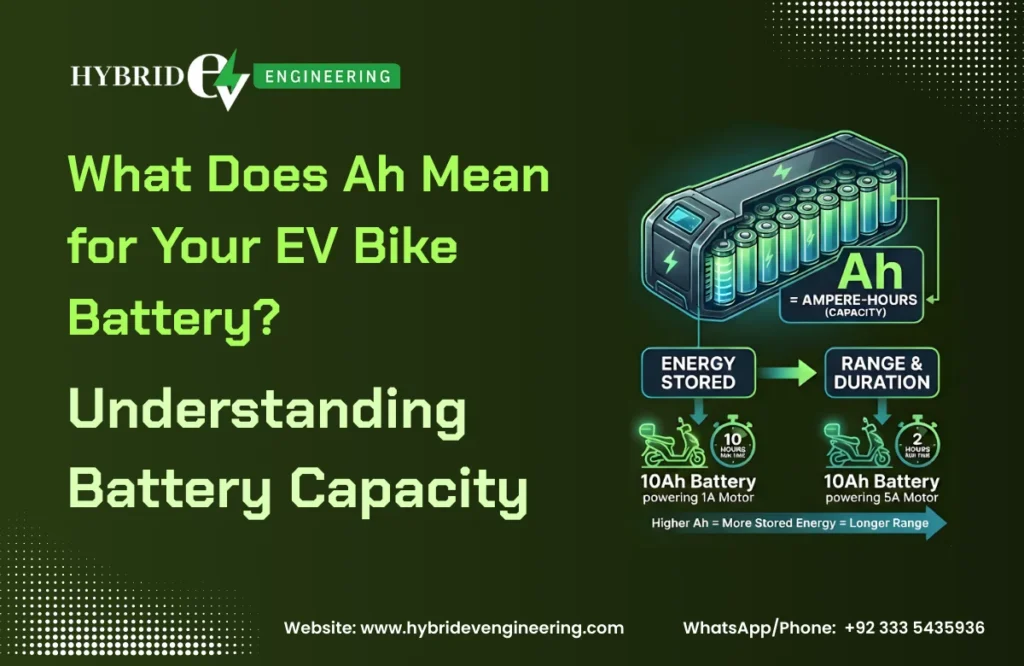
Understanding Battery Capacity | What Does Ah Mean for Your EV Bike?
When buying an electric bike or upgrading your battery, one of the biggest confusions people have is about Ah (Ampere-hour).…
EV Bike Batteries
Can You Upgrade Your Lead Acid EV Bike to Lithium? Step-by-Step Guide
If you own an electric bike in Pakistan with a lead acid or gel battery, you have probably noticed the…