
48V Lithium Battery for Electric Bike Price in Pakistan
A plain price and spec guide to 48V lithium packs for e-bikes and scooties in Pakistan: what 20Ah, 30Ah, 40Ah and 60Ah cost, what range they give, and what to check before you pay.

Your 48V e-bike or scooty has started to feel tired. The range has dropped, the charger takes longer than it used to, and you are charging twice a day for the same school run or office commute you did on one charge last year.
The next question is money. A 48V lithium pack is a real purchase, and the price changes a lot with capacity, cell quality and warranty. Cheap packs exist, and so do overpriced ones with undersized cells inside.
This guide settles the numbers. You will see the current price of each 48V capacity, the range each one gives in real riding, how to check your controller is compatible, and what a fair warranty looks like in Pakistan.
Quick answer
What is the 48V lithium battery for electric bike price in Pakistan?
The 48V lithium battery for electric bike price in Pakistan starts at Rs 56,000 for a 20Ah pack and goes to Rs 150,000 for 60Ah, as checked in October 2026. Range runs from about 30-40 km on the 20Ah to 100-120 km on the 60Ah, and every pack carries a 3-year warranty.
What is the price of a 48V lithium battery for an electric bike in Pakistan?
A 48V lithium pack for an e-bike or scooty in Pakistan costs between Rs 56,000 and Rs 150,000, depending on capacity. The 20Ah is the entry pack, the 30Ah and 40Ah are the middle choices, and the 60Ah is for long daily rides or commercial use.
These are workshop-built packs, not imported boxes sitting in a warehouse. Each one uses EVE cylindrical cells and a smart BMS, and each is load tested before it leaves. The EV Bike Battery range covers 48V, 51.2V, 60V, 63V, 72V and 76V, so you can match your controller exactly rather than settling for whatever is in stock.
| Capacity | Range (km) | Price (PKR) |
|---|---|---|
| 20 Ah | 30-40 km | Rs 56,000 |
| 30 Ah | 50-60 km | Rs 82,000 |
| 40 Ah | 65-80 km | Rs 103,000 |
| 60 Ah | 100-120 km | Rs 150,000 |
Prices were checked in October 2026 and are confirmed after your bike model is verified, because the pack shape and connector have to match your compartment. Call or WhatsApp 0333-5435936 with your bike model and a photo of the battery tray for a free quote.
How do 20Ah, 30Ah and 40Ah 48V packs differ in range and price?
Capacity decides range, and range is the only honest way to pick a pack. Work out your real daily kilometres first, then add a margin for summer heat, load and hills.
- 20Ah (Rs 56,000): about 30-40 km. Fits a short commute, a school run, or a second bike used around the neighbourhood.
- 30Ah (Rs 82,000): about 50-60 km. The most common choice for a working rider who does one full trip and back without charging at the destination.
- 40Ah (Rs 103,000): about 65-80 km. Good for delivery riders, two-person use, or routes with long stretches of open road.
- 60Ah (Rs 150,000): about 100-120 km. Built for commercial riders and anyone who cannot charge at home every night.
Do not buy more capacity than you need. Extra Ah adds weight and cost, and a heavy pack on a small motor helps nobody. Buy the capacity that covers your longest normal day, not your once-a-month trip.
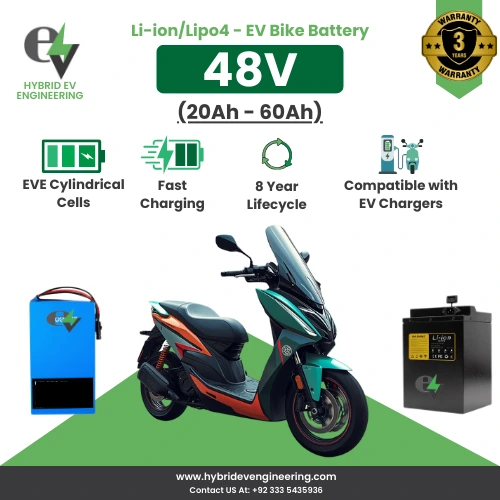
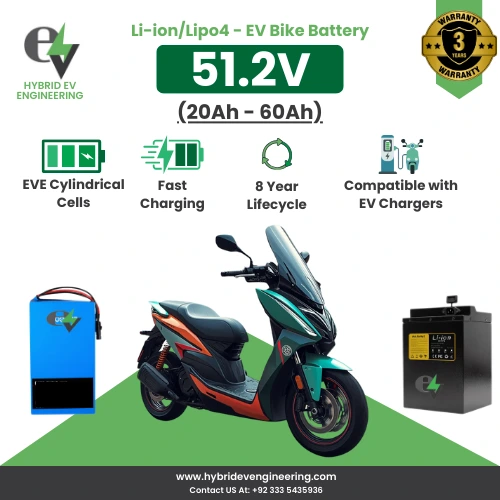
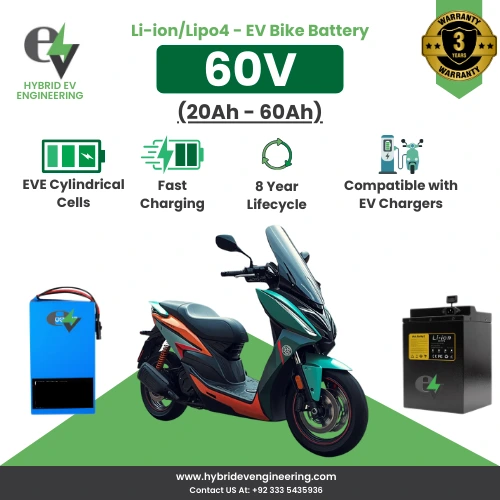
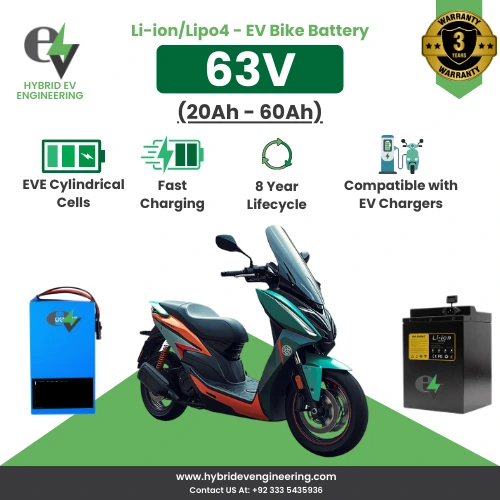
If your bike is not 48V, do not force it. A 60V bike needs a 60V pack, and a 72V bike needs a 72V pack. The 48V Li-ion / LiFePO₄ EV Bike Battery (20Ah–60Ah) is the right starting point for entry-level e-bikes and scooties, and the other voltages follow the same capacity and price logic.
Li-ion vs LiFePO4 for 48V e-bikes: which is better value?
Both chemistries work in a 48V e-bike. LiFePO4 is the safer, longer-lived choice; Li-ion is lighter and often a little cheaper for the same capacity. For most riders in Pakistan, LiFePO4 is the better long-term buy.
LiFePO4 tolerates heat better and holds its voltage more steadily as it drains, so you do not get that sudden power drop near the end of a ride. It is also harder to damage through over-charging. Li-ion gives you a lighter pack, which matters on a small scooty where every kilogram is felt.
Either way, the cells matter more than the label. EVE cylindrical cells are a known quantity and behave predictably over years of use. A pack built from unbranded cells will show its real cost in the second summer, when range falls off faster than it should.
How do I check my bike’s controller accepts a 48V lithium pack?
Check the controller label and the old charger before you order. The controller’s rated voltage must match the pack, and the charger’s output must suit lithium, not lead acid.
- Find the controller, usually a metal box under the seat or behind a side panel. Read the sticker: it will say something like 48V, 60V or 72V.
- Look at the old charger’s output voltage. A 48V lead acid charger is not the same as a 48V lithium charger, and using the wrong one can trip the BMS or damage cells.
- Measure the battery compartment. A 60Ah pack is physically bigger than a 20Ah one, and it has to fit without pressing on wiring.
- Note the connector type and charge port. These are matched to your existing setup at no extra cost at a given voltage and capacity.
If you cannot read the label, send a photo of the controller sticker and the battery tray on WhatsApp. That is usually enough to confirm the voltage and shape in one message.
Not sure which pack fits your bike?
Send your bike model, a photo of the controller label and a photo of the battery tray on WhatsApp. You get back the correct voltage, the capacity options with range and price, and the pack shape that fits your compartment.
What BMS protections should a quality 48V pack have?
A smart BMS should protect against over-charging, deep discharge, over-current, short circuits and thermal imbalance. If a seller cannot tell you what the BMS does, that is your answer.
The BMS is the part that keeps a pack alive. It balances cells so one weak cell does not drag the whole pack down, and it cuts the current when something goes wrong. On a cheap pack, the BMS is often the first thing cut to save cost, and it is the reason those packs fail early.
- Over-charge protection: stops the charger from pushing the pack past its safe voltage.
- Deep discharge protection: cuts power before the cells are drained too far, which is what kills lead acid packs.
- Over-current and short circuit protection: matters on steep climbs and with a heavy rider.
- Thermal protection: relevant in a Pakistani summer, when a pack left in the sun gets hot before you even ride.
Every pack from the workshop is load tested and its BMS checked before it leaves, so you are not the one discovering a fault on the first ride.
Custom shapes and connectors: is there extra cost?
No. Custom packs are built to the shape of your bike or scooty battery compartment at no extra charge for a given voltage and capacity, and the connector and charge port are matched to your existing setup.
This matters more than most buyers expect. Two 48V bikes from different brands can have completely different trays, and a pack that does not sit flat will rub, vibrate and eventually fail. A built-to-shape pack sits the way the original did.
Free professional installation is available at the I-9/3 Islamabad workshop. If you are outside Islamabad, the pack ships in safe packaging with wiring guidance, and you can have it fitted by your own mechanic.
Warranty and lifecycle: what does 3 years cover?
Every EV bike battery carries a 3-year warranty, and custom-built packs carry the same terms as standard packs. The pack is rated for up to 4000 charge cycles and a service life of up to 8 years with proper charging.
Compare that with the graphene or lead acid pack most entry e-bikes ship with. Those typically last 2 to 3 years in Pakistani conditions and manage roughly 300 to 500 charge cycles. Over the life of the bike, the lithium pack is usually the cheaper option even though it costs more on day one.
Keep your invoice. Warranty claims are simple with it and slow without it. Also keep the charger that came with the pack, since a mismatched charger is the most common cause of avoidable damage.
The model names above are the ones the workshop regularly fits. If your bike is not listed, the voltage and tray size still decide the pack, so send the details and the shape gets built to match.
Delivery and installation options across Pakistan
Delivery is nationwide in safe packaging. Islamabad and Rawalpindi get same-day or next-day delivery, major cities take 2-3 business days, and other locations take 3-5 business days.
If you are in the twin cities, bring the bike to the I-9/3 Islamabad workshop for free professional installation. There is also a branch on Old Airport Road in Rawalpindi. A free battery health diagnosis is available at the Islamabad workshop, which is worth doing before you buy if you are unsure whether your current pack is failing or the controller is the problem.
Outside Islamabad, the pack arrives with wiring guidance. Most riders hand it to a local mechanic for fitting, and the connector match means it is a straight swap rather than a rewiring job.
How do I avoid overpaying for undersized cells?
Ask three questions before you pay: what cells are inside, what the BMS protects against, and what the warranty actually covers in writing. A seller who answers all three clearly is usually selling an honest pack.
- Undersized cells: a pack can say 48V 30Ah and still use cells that sag under load. The range looks fine on paper and disappears on a climb.
- No load test: a pack that was never load tested can pass a voltage check and still fail on the road.
- Vague warranty: “3 years” means little if it excludes everything that normally goes wrong. Ask what is covered and what voids it.
- Wrong voltage sold as close enough: a 60V bike on a 48V pack will run badly or not at all. Match the controller.
For a wider look at fit and connectors, read the custom fit guide for e-bikes and scooties in Pakistan. If you ride a Jolta, the Jolta battery guide covers the 60V and 72V systems most of those bikes use.
Frequently Asked Questions
What is a 63V lithium battery used for in electric bikes?
A 63V pack suits controllers that accept a slightly higher voltage than 60V, giving stronger torque and better efficiency without moving to a 72V system. It is common on mid-range e-bikes and scooties where the controller allows it. Check your controller label first, because a 60V bike that does not allow 63V should stay on a 60V pack.
How far can a 48V 20Ah LiFePO4 battery take an e-bike on one charge?
About 30-40 km in normal riding. Range drops with a heavier rider, hills, tyre pressure and summer heat. If your daily ride is close to 40 km, move up to the 30Ah pack so you are not running the battery to empty every day, which shortens its life.
How do I wire a 48V lithium battery into my electric bike?
Match the connector to your existing setup, connect the main leads with the correct polarity, then connect the charge port. The BMS handles protection, so no extra wiring is needed. If you are not confident with polarity, have it fitted professionally. Free installation is available at the Islamabad workshop.
How far can a 48V 30Ah LiFePO4 battery take an e-bike?
About 50-60 km on a single charge. That covers a full office or school trip and back for most riders in Pakistani cities, with a margin for heat and load. It is the most common capacity chosen for daily commuting because it avoids charging twice a day.
What charger should I use for a 48V lithium EV bike battery?
Use a 48V lithium charger with the correct output voltage and current for your pack. Do not use a lead acid charger, even if it says 48V, because the charging profile is different and can trip the BMS or shorten cell life. The pack works with standard EV chargers that match its voltage.
Is a 48V LiFePO4 battery better than a 48V lead-acid battery for an e-bike?
Yes, for almost every rider. A lithium pack is lighter, gives more usable range, and lasts far longer: up to 4000 charge cycles against roughly 300 to 500 for lead acid. It costs more upfront, but over the life of the bike it usually works out cheaper.
Final Thoughts
The short version:
- A 48V lithium battery for an electric bike in Pakistan runs from Rs 56,000 for 20Ah to Rs 150,000 for 60Ah, checked in October 2026.
- Pick capacity by your longest normal day, not your biggest trip of the month.
- Match the voltage to your controller label, and match the charger to lithium.
- LiFePO4 is the better long-term buy for most riders in Pakistani heat.
- Ask what cells, what BMS protections and what the 3-year warranty covers before you pay.
- Custom shapes and connectors cost no extra at a given voltage and capacity.
If you are still unsure between two capacities, send your daily kilometres and bike model to the WhatsApp box below and get a straight answer before you spend.
Get Your Battery Quote
 EV Bike Batteries
Evee Electric Bike Battery Replacement Price in Pakistan
Your Evee was doing 80 kilometres on a charge when you bought it. Now it barely manages 40, and it…
EV Bike Batteries
72V Lithium Battery Price in Pakistan: Complete Buying Guide 2026
Looking for a lithium battery for your electric bike in Pakistan? Compare 48V, 60V, 72V and 76V prices, range, and which pack suits your ride.
 EV Bike Batteries
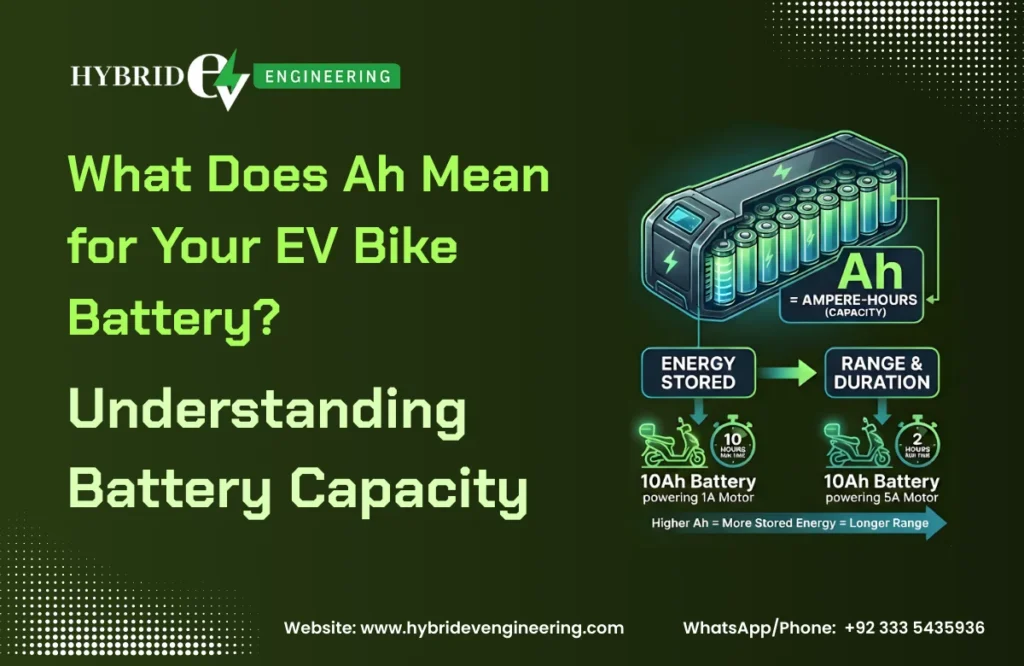
Understanding Battery Capacity | What Does Ah Mean for Your EV Bike?
When buying an electric bike or upgrading your battery, one of the biggest confusions people have is about Ah (Ampere-hour).…