

High vs Low Voltage Solar Battery: Which Fits Your Home?
A plain comparison of high voltage and low voltage solar storage for Pakistani homes: which inverter takes which, how each handles long cable runs and summer heat, and how to choose before you spend.

Most solar buyers in Pakistan spend weeks on panel brands and almost no time on the one decision that shapes the whole system: the battery voltage. Then the inverter arrives, the battery does not match, and the wiring has to be redone.
The high vs low voltage solar battery question is really about your inverter, your cable runs and how much you plan to add later. Get that right and the rest of the system falls into place.
This post settles the comparison with the facts we work with in our Islamabad workshop, so you can choose an architecture before you pay for anything.
Quick answer
High vs low voltage solar battery: which should I choose?
A low voltage solar battery (48V class) suits most homes up to roughly 5kW to 10kW and is easy to expand. A high voltage solar battery (90V to 1000V DC) suits larger loads, long cable runs and hybrid inverters built for it. Match your inverter first, then pick capacity.
What counts as high voltage vs low voltage storage?
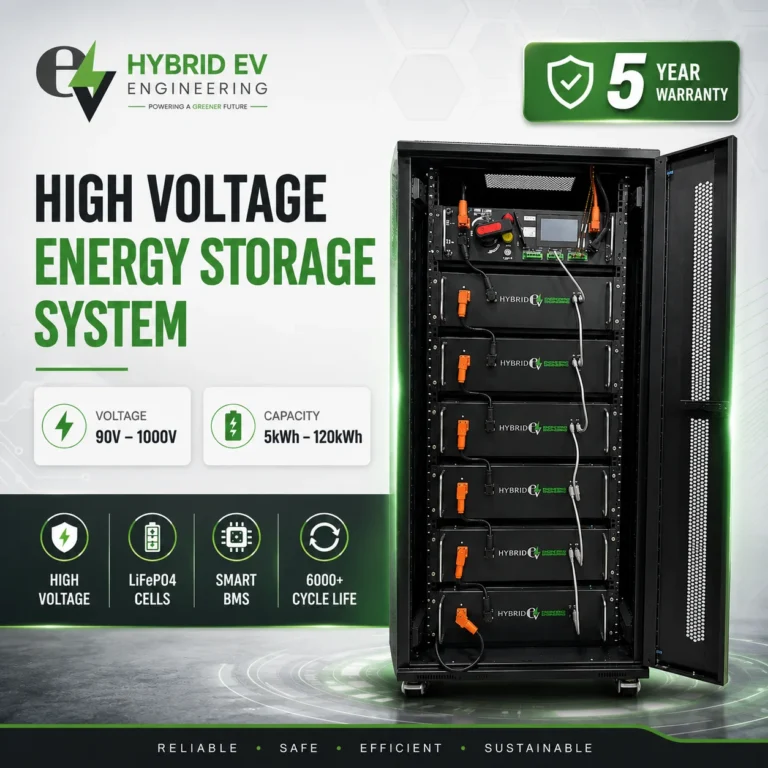
Low voltage storage sits in the 48V class, typically 48V or 51.2V nominal. High voltage storage starts around 90V DC and runs up to 1000V DC in the packs we build. The dividing line is not a marketing label; it is what your inverter and charge controller are designed to accept.
In our workshop, most home solar work is still 48V class. High voltage packs come in when the load is heavy or the cable run is long.
| Point | Low voltage (48V class) | High voltage (90V – 1000V DC) |
|---|---|---|
| Typical use | Homes, small shops, backup | Larger homes, commercial, industrial |
If your inverter manual says 48V DC input, that is your answer. If it says a high DC input range, a low voltage battery will not start it at all. We see this mismatch often when someone buys a battery before reading the inverter label.
Which inverters need which battery voltage?
Your inverter decides the voltage, not the other way round. A 48V hybrid inverter needs a 48V class battery. A high voltage hybrid inverter needs a pack inside its stated DC window, and the pack’s BMS has to talk to that inverter.
For a wider look at where high voltage packs are used beyond solar, our guide on what a high voltage battery is and where it is used covers traction, machinery and storage in plain terms.
Which is more efficient over long cable runs?
High voltage wins on long runs. For the same power, a higher voltage means lower current, and lower current means less heat and less loss in the cable. This is the main technical reason high voltage storage exists.
On a rooftop where the battery sits close to the inverter, the difference is small. On a large house or a commercial site where the battery bank sits in a separate room or outside, it becomes real. A low voltage system pushing heavy current through a long cable run wastes energy as heat and needs thicker, more expensive copper.
- Short run, small system: low voltage is fine and simpler to wire.
- Long run or heavy load: high voltage keeps cable size and losses down.
- Very hot cable or warm terminals: a sign the current is too high for the cable, check it before ignoring it.
This is also why high voltage packs are the norm above roughly 20kW to 30kW of continuous load. A 48V system carrying that much power needs very large cables and generates noticeable heat.
Which is easier to expand later?
Low voltage is easier to expand for most homes. You add another 48V battery in parallel, ideally the same model and age, and the capacity grows.
High voltage expansion is possible but stricter. Modules go in series, so every module must match, and the BMS has to be built to accept the extra modules. Adding a mismatched module to a high voltage string is a real risk, not a small one.
- Planning to grow slowly: start low voltage and add packs as the budget allows.
- Planning one big system: size the high voltage pack correctly at the start, with headroom.
- Unsure: tell us the load you expect in two or three years, not just today.
How does heat in Pakistan affect each option?
Heat affects both, but high voltage packs concentrate more cells and more electronics in one enclosure, so ventilation and placement matter more. A battery room in Lahore or Multan in June is not the same as a shaded cabinet.
Both types should sit out of direct sun, with airflow around the enclosure. Lithium cells degrade faster when kept hot and fully charged, so a shaded, ventilated spot adds years to either option. Our lithium solar battery range is built for these conditions, and the same placement rules apply to high voltage cabinets.
Do not stack a pack against a west-facing wall that bakes all afternoon. That single choice causes more premature failures than most people expect.
Which suits a small home vs a large setup?
A small or mid-size home with a standard hybrid inverter is almost always a low voltage job. A large home, commercial site or industrial load with a high voltage inverter is where high voltage storage pays off.
Think about your actual load, not the panel count. A house running fans, lights, a fridge and a few ACs on a 5kW to 10kW inverter is a low voltage case. A site running heavy motors, chillers or machinery is a high voltage case.
If you are still deciding on the battery side for a smaller home, our EV bike battery range shows the same cell and BMS approach we use in small packs, scaled up for home storage.
What does a high voltage solar battery cost?
High voltage storage is a bigger spend because it is built to order. Our custom high voltage packs start at Rs 600,000 and are priced by configuration: voltage, capacity in kWh, BMS and enclosure all change the figure.
Low voltage packs are cheaper per unit and easier to buy off the shelf, but you may need more of them and thicker cable. Compare the whole installed cost, not just the battery price. For a full walkthrough of a build, see our custom high voltage battery build guide for Pakistan.
How do you get the right pack built for your system?
Send us your inverter model and a photo of its DC input label, plus your load list. We match the voltage window, size the capacity in kWh and confirm the BMS protocol before anything is built.
Not sure which voltage your inverter needs?
WhatsApp us a photo of your inverter’s DC input label and your load list. We will confirm the right voltage window, the capacity in kWh and a price for the build.
What is a high voltage battery in a car, and is it the same idea?
Yes, the principle is the same. A hybrid or electric car uses a high voltage traction battery, often in the hundreds of volts, because it moves a lot of power through relatively thin cables. The difference is that a car pack is built around the vehicle, while a solar pack is built around your inverter.
Car high voltage systems also bring safety rules. Never open a high voltage pack or disconnect its service plug without training and the right tools. If your hybrid shows a voltage isolation fault, stop and get it checked; our post on the POAA6 hybrid battery voltage isolation fault explains what that warning means.
For home solar, the safe rule is the same: the pack stays sealed, and only trained hands open it.
Frequently Asked Questions
What is a high voltage battery and where is it used?
A high voltage battery runs from about 90V to 1000V DC. It is used where the load is heavy or the cable run is long: commercial and industrial solar storage, electric vehicles, hybrid cars, heavy machinery and traction systems. The higher voltage keeps current low, so cables stay thinner and less energy is lost as heat.
What is the difference between high voltage and low voltage batteries for solar?
Low voltage storage sits in the 48V class and works with most home hybrid inverters. High voltage storage runs from 90V to 1000V DC and needs an inverter rated for that input. High voltage carries the same power at lower current, so it loses less over long cable runs and suits larger loads.
Can I use a high voltage lithium battery for solar energy storage at home?
Yes, if your inverter is rated for high DC input and its BMS protocol matches the pack. Many larger homes and commercial sites run high voltage storage. If your inverter says 48V DC input, a high voltage pack will not work and you need a 48V class battery instead.
How do I safely disconnect a high voltage battery?
Do not do it yourself unless you are trained. High voltage DC can injure or kill. Shut down the inverter and solar input first, then follow the manufacturer’s isolation procedure. For car packs, the service plug must be removed by a qualified technician. For home packs, call a trained installer.
Is a high voltage solar battery worth it for a small home?
Usually not. A small home on a standard hybrid inverter is better served by a 48V class battery, which is cheaper, widely available and easy to expand. High voltage pays off when the load is heavy or the cable run is long, which is rare in a small house.
Which is better in Pakistan’s summer heat, high or low voltage?
Neither is immune to heat. Both need shade and airflow, and both degrade faster when kept hot and fully charged. High voltage cabinets pack more cells and electronics in one enclosure, so ventilation and placement matter more. A shaded, ventilated spot helps either type last longer.
Final Thoughts
The short version:
- Your inverter decides the voltage, so read its DC input label first.
- Low voltage (48V class) suits most homes up to roughly 5kW to 10kW and is easier to expand.
- High voltage (90V to 1000V DC) suits heavy loads and long cable runs, with less loss and thinner cable.
- Heat matters for both; shade and airflow add years to either pack.
- High voltage is a bigger spend, starting at Rs 600,000 for our custom builds.
Send us your inverter label and load list through the WhatsApp box below, and we will confirm the right architecture before you spend.
Get Your Battery Quote
 Lithium Solar Batteries
Electric Fork Lifter Battery: Complete Guide
An electric fork lifter battery is the primary power source that allows an electric forklift to move, lift, and perform…
 Lithium Solar Batteries
12V 100Ah Lithium Solar Battery: Buying Guide for Pakistan
A practical guide to the 12V 100Ah lithium solar battery in Pakistan: what it powers, what it costs, and when to step up to 24V or 51.2V.
Lithium Solar Batteries
High Voltage Battery: What It Is and Where It Is Used
A high voltage battery moves the same power at lower current, so cables run cooler and inverters stay efficient. Learn what it is, how it differs from low voltage, and where 90V to 1000V packs are used.