

High Voltage Battery: What It Is and Where It Is Used
A high voltage battery moves the same power at lower current, so cables run cooler and inverters stay efficient. Learn what it is, how it differs from low voltage, and where 90V to 1000V packs are used.

You have probably seen the term high voltage battery on a spec sheet or heard it from an installer, and it sounds like something only big factories need. In practice, the idea is simple: push the same power through a pack at higher volts and the current drops, so the cables get thinner, the heat drops, and the inverter runs closer to its sweet spot.
This post settles what a high voltage battery is, how it differs from a low voltage one, how to charge it safely, and what a 90V to 1000V custom pack can actually run. It is written for Pakistani conditions, where summer heat and unstable grid power both matter.
Quick answer
What is a high voltage battery?
A high voltage battery is a pack that runs at a higher bus voltage, usually above 90V, so the same power flows at lower current. That means thinner cables, less heat, and better inverter efficiency. Hybrid EV Engineering builds custom high voltage battery packs from 90V to 1000V in Islamabad.
What is a high voltage battery and where is it used?
A high voltage battery is a rechargeable pack designed to operate at a bus voltage well above the 48V to 76V range used by e-bikes and small scooties. In practice, anything from about 90V upward is treated as high voltage in this market, and industrial systems often run at 400V, 600V or even 1000V.
The reason is simple physics. Power equals volts times amps. If you double the voltage, you halve the current for the same power. Lower current means less heat in the cables, thinner copper, and an inverter or motor controller that stays closer to its efficiency peak. That is why a 1000V battery pack makes sense for a heavy load, while a 48V pack would need fat cables and would still run hot.
Where you see them:
- Electric buses, trucks and heavy machinery.
- Industrial energy storage and grid support.
- Large solar farms with high-voltage inverters.
- Some hybrid and electric cars use high voltage battery packs, though the exact voltage depends on the model.
If you are working on a smaller vehicle, a 48V or 72V lithium pack is still the right answer. You can see those in our EV Bike Battery range.
High voltage battery vs low voltage battery: what changes?
The main difference is current. A high voltage battery delivers the same power at lower current, so the whole system runs cooler and the wiring is lighter. A low voltage battery, like a 48V pack, needs thicker cables and produces more heat for the same load.
Here is a side-by-side look at the two approaches.
| Feature | Low voltage (48V – 76V) | High voltage (90V – 1000V) |
|---|---|---|
| Typical use | E-bikes, scooties, small solar | Heavy machinery, buses, industrial storage |
| Cable size | Thick copper needed | Thinner copper for same power |
| Heat at high load | Noticeably more | Noticeably less |
| Inverter efficiency | Lower at high power | Higher, closer to peak |
| Safety gear | Basic insulation | Proper HV gloves and tools required |
| Cost of pack | Lower per kWh | Higher per kWh, but saves on wiring and cooling |
So the choice is not about which is better in general. It is about the load. If your continuous draw is above roughly 20kW to 30kW, a high voltage battery is the practical choice. Below that, a 48V or 72V lithium pack is simpler, cheaper and easier to service.
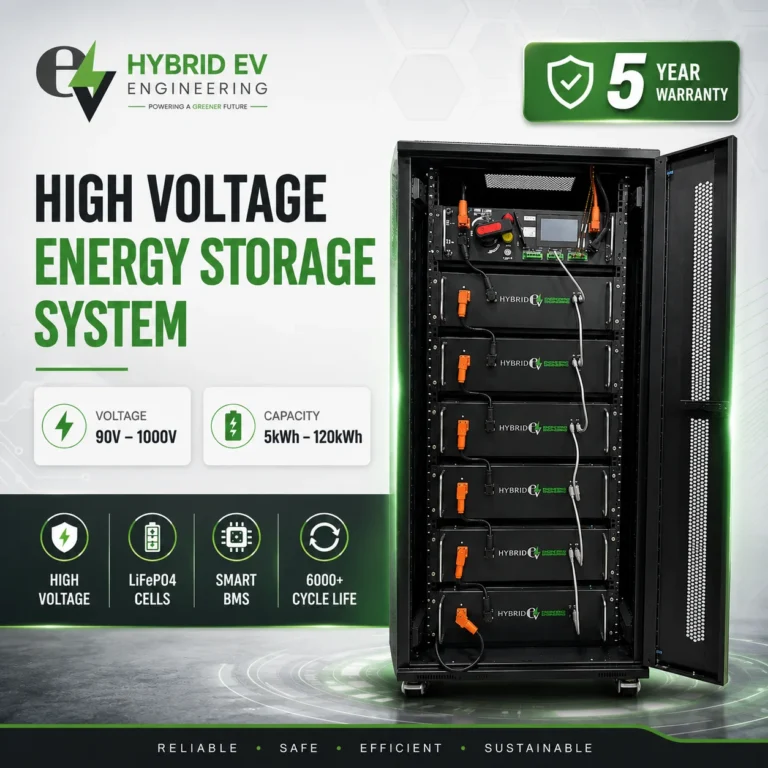
What can a 90V to 1000V custom high voltage battery be used for?
A custom high voltage battery in the 90V to 1000V range can run industrial machinery, traction systems, large solar storage and commercial backup where a 48V bank cannot carry the load. The exact voltage is matched to your inverter or motor controller, not picked from a shelf.
Common applications in Pakistan include:
- Industrial equipment and heavy machinery that draws more than 20kW to 30kW continuously.
- Electric buses, trucks and specialized vehicles.
- Commercial and industrial energy storage for factories and large buildings.
- Renewable energy projects where the inverter expects a high DC input.
Because every project is different, these packs are built to order. Our Custom High Voltage Battery 90V–1000V is configured around your inverter, controller and duty cycle, with LiFePO4 or NMC cells and a smart master-slave BMS.
How do I charge a high voltage battery safely?
Charging a high voltage battery safely means using a charger that matches the pack voltage and chemistry, never exceeding the BMS limits, and keeping the pack within its temperature range. In Pakistan, summer heat makes temperature the biggest risk.
Follow these steps:
If you are not sure about your charger or BMS settings, get the pack checked before you keep using it. A wrong charger is one of the fastest ways to shorten battery life.
What is the difference between a 90V battery and a 1000V battery?
A 90V battery and a 1000V battery differ mainly in how much power they can move efficiently and what equipment they can feed. Higher voltage means lower current for the same power, so a 1000V pack suits much larger loads than a 90V pack.
Think of it this way:
- A 90V battery is often used for smaller industrial systems, some traction applications, and medium-sized storage where the inverter expects a lower DC input.
- A 1000V battery is for large industrial or grid-scale systems where the inverter is designed for a high DC bus and the load is heavy.
The right choice is not about which number sounds better. It is about what your inverter, motor controller or charger expects. Sending 1000V into a 90V system will destroy it, and a 90V pack will not run a 1000V inverter properly.
This is why we build to your specification. You tell us the inverter model and the load, and we configure the voltage and capacity to match.
Can I use a high voltage battery for solar storage in Pakistan?
Yes, high voltage batteries are used for solar storage, but only with inverters that are designed for a high voltage DC input. Most home solar inverters in Pakistan run on 48V, while larger commercial inverters may expect a higher voltage.
If your inverter is a 48V model, a high voltage battery is not the right fit. You would use a 48V lithium solar battery instead. If your inverter is a high voltage type, then a custom high voltage battery can make sense, especially for a factory or large building where the load is heavy and the cable runs are long.
For home solar, our Lithium Solar Battery range covers the common 48V setups. For industrial solar, a high voltage battery built to your inverter’s spec is the better route.
Why does voltage matching matter so much?
Voltage matching matters because the inverter, motor controller or charger is designed for a specific DC window. If the battery voltage is outside that window, the equipment may not run at all, or it may run inefficiently and fail early.
In our workshop, we see this most often when someone buys a pack based on the number alone, without checking the controller. A 72V bike needs a 72V pack, and a 60V bike needs a 60V pack. The same rule applies at high voltage, just with bigger numbers.
Before you order, confirm:
- The input voltage range of your inverter or controller.
- The maximum charge voltage your BMS allows.
- The continuous and peak current your load draws.
- The space you have for the pack, including ventilation.
If you send us these details, we can configure a pack that fits without guesswork.
Not sure which voltage fits your setup?
Send us your inverter or controller model, the load in kW, and the space you have. We will reply with a voltage and capacity recommendation, a budgetary price, and the lead time.
What should I check before buying a high voltage battery?
Before buying a high voltage battery, check the inverter or controller input range, the continuous load, the space for the pack, and the warranty terms. Getting these four right prevents most costly mistakes.
Also ask about the BMS. A smart master-slave BMS with CAN and RS485 communication lets the battery talk to your inverter, which improves safety and lets you monitor cell health. If the BMS cannot communicate, you lose that visibility.
Finally, confirm who will service the pack. High voltage systems need proper tools and training. A local supplier who can inspect and repair the pack is worth more than a slightly lower price from far away.
Frequently Asked Questions
What is a high voltage battery and where is it used?
A high voltage battery is a pack that operates at a higher bus voltage, usually above 90V, so the same power flows at lower current. It is used in heavy machinery, electric buses, industrial energy storage, large solar systems and some hybrid or electric cars. The exact voltage depends on the inverter or motor controller it feeds.
What is the difference between high voltage and low voltage batteries?
The main difference is current. A high voltage battery delivers the same power at lower current, so cables can be thinner, heat is lower and the inverter runs more efficiently. A low voltage battery, like a 48V pack, needs thicker cables and produces more heat for the same load. The right choice depends on your load size.
How do I charge a high voltage lithium battery safely?
Use a charger rated for your pack voltage and chemistry, never exceed the BMS charge limits, and charge in a ventilated, shaded spot. In Pakistani summers, charge when the ambient temperature is lower, and stop if the pack feels hot. Do not leave the pack at full charge for long periods if it will sit unused.
What can a 90V to 1000V custom high voltage battery be used for?
A custom pack in this range can run industrial machinery, traction systems, electric buses and trucks, commercial energy storage, and large solar projects where the inverter expects a high DC input. The voltage is matched to your inverter or controller, and the capacity is sized to your daily energy use and duty cycle.
Can I use a high voltage battery with a 48V solar inverter?
No. A 48V inverter expects a 48V battery, and a high voltage pack will not work with it. High voltage batteries are used with inverters designed for a high voltage DC input, which are more common in commercial and industrial solar installations. For home solar, a 48V lithium battery is the correct match.
How do I know if I need a high voltage battery instead of a 48V pack?
If your continuous load is above roughly 20kW to 30kW, a high voltage battery is usually the practical choice because the current stays manageable and the wiring stays lighter. Below that, a 48V or 72V lithium pack is simpler, cheaper and easier to service. Check your inverter or controller input range first.
Final Thoughts
The short version:
- A high voltage battery runs above roughly 90V, so the same power flows at lower current.
- Lower current means thinner cables, less heat and better inverter efficiency.
- High voltage suits loads above about 20kW to 30kW; smaller vehicles still do well on 48V to 76V.
- Voltage must match your inverter or controller, not the other way around.
- Charging safely means the right charger, BMS limits respected, and temperature control.
- Custom packs from 90V to 1000V are built around your equipment, not pulled off a shelf.
If you are still deciding, our guide on hybrid battery tips covers everyday care that applies to any lithium pack. For a pack built to your spec, message us on WhatsApp below.
Get Your Battery Quote
 Lithium Solar Batteries
Best Lithium Solar Battery for Home in Pakistan: 2026 Guide
Solar power adoption in Pakistan is growing rapidly. Rising electricity costs, frequent load shedding, and increasing awareness of clean energy…
 Lithium Solar Batteries
Electric Fork Lifter Battery: Complete Guide
An electric fork lifter battery is the primary power source that allows an electric forklift to move, lift, and perform…